How AI Helped Investigate the Binance Hack
At Binance Blockchain Week, TRM Labs explained why an AI alert alone could not establish that funds had been stolen and how investigators made that call.
Table of contents





At Binance Blockchain Week in Bangkok, TRM Labs representative Jonno Newman said an artificial intelligence (AI) system raised an alert within the first hour of the October 29 Binance hack. Human investigators made the decision to classify the funds as potentially stolen. Binance’s initial report on November 3 put the affected assets at about $6.34 billion and said roughly $2.85 billion had been frozen or intercepted by the time of publication.
Why the AI alert wasn’t enough
A large transfer alone did not establish that a theft had occurred. It could have been a routine move between hot wallets or the result of changes to Binance’s internal infrastructure. Newman said the team classified the funds as potentially stolen within the first hour, but the system did not make that judgment.
How investigators tracked the funds
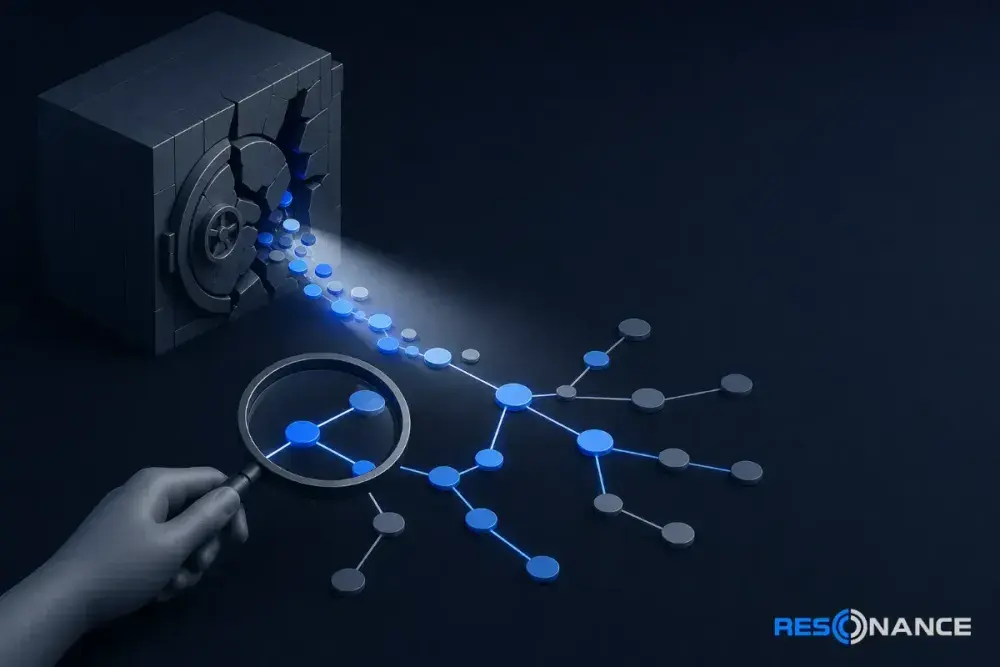
In a November 19 post, Chainalysis said it used its Chain platform to match transactions involving cross-chain bridges. Analysts first identified recurring routes, then automated repetitive parts of the work involved in tracking token swaps, recipients and onward transfers.
In an update on November 26, Elliptic said the stolen funds had passed through more than 27,000 wallets across at least 16 blockchains. Fixed transfer intervals and amounts, as well as retries after errors, looked more like conventional automation than an AI agent making its own decisions. That assessment covers the movement of funds, not other stages of the attack.
Why the withdrawal pause didn’t stop the transfers
Binance said some permissions remained active onchain independently of its normal withdrawal system and had to be revoked separately. Preliminary findings traced the attack to a fake job interview. The attackers also used an internal AI tool to gain access to two more engineers’ computers. Binance subsequently rebuilt the affected wallet infrastructure and internal AI system and strengthened anomaly detection.
What's on the market now
Analysis for traders
- Strengths. An alert within the first hour and $2.85 billion frozen or intercepted by November 3 give traders two ways to assess Binance’s response: how quickly the incident was detected and how much of the affected assets were contained.
- Weaknesses. Pausing Binance withdrawals did not revoke onchain permissions. For risk management, a suspension in the exchange interface should not be taken as proof that unauthorized transfers have stopped.
- Opportunities. The routes identified by Chainalysis may help traders distinguish further movements of stolen assets from ordinary bridge activity.
- Threats. With funds dispersed across more than 27,000 wallets, it may be harder to assess how much is still moving and where further freezes are possible.
What to watch next
- Any change in the amount frozen or intercepted from the $2.85 billion reported on November 3.
- Evidence of new routes through bridges or further token swaps.
- Any Binance update on which onchain permissions were revoked and what changed in its wallet infrastructure.
Source: ForkLog
No need to invent complex schemes or hunt for the “grail”. Use the tools of the Resonance platform.
Sign up on exchanges via our links and get bonuses:
OKX | BingX | KuCoin.
Prop firm — trade with the company’s capital: Kraken.
Promo code TOPBLOG gives you 10% off any Resonance plan.


Recommended articles