Tokenized Deposit Advocate Nominated to Lead ECB
The ECB nominee sees tokenized deposits handling most payments and stablecoins serving narrower uses. Here is what traders should watch as the appointment and payment trials move forward.
Table of contents










On November 26, the European Council nominated Pablo Hernández de Cos, general manager of the Bank for International Settlements (BIS), to lead the European Central Bank (ECB). If confirmed, he will succeed Christine Lagarde on February 7, 2027, for a nonrenewable eight-year term.
Why he favors tokenized deposits
Hernández de Cos argues that pegging USDT and USDC to the same dollar does not guarantee they can be swapped at par. Their prices can differ on secondary markets, and the gaps can widen during financial stress. Tokenized deposits, by contrast, remain liabilities that commercial banks owe their customers. In his proposed model, banks settle with one another in central bank money to preserve parity between deposits at different institutions.
He also points to the cost and risk of moving stablecoins across networks and the difficulty of meeting anti-money-laundering requirements for transfers between self-custody wallets. Tokenized deposits face an interoperability problem of their own. He sees tokenized central bank reserves as one possible solution.
What is already being tested
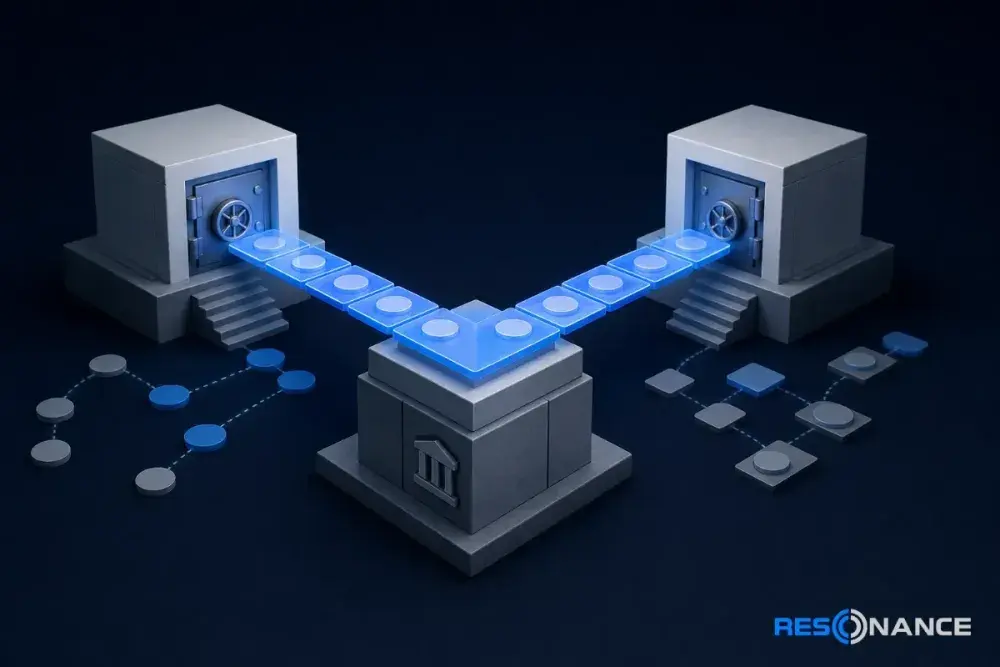
Project Agorá developed a prototype for cross-border payments using tokenized bank deposits and central bank reserves. In July 2026, 28 financial institutions and central banks ran test transactions with real funds in several currencies worth the equivalent of 800,000 Swiss francs. Payments took about 80 seconds on average from initiation to settlement.
Separately, the ECB is preparing a 12-month digital euro pilot with 36 payment service providers, due to start in the second half of 2027. A possible 2029 launch depends on legislation passing by the end of 2026. The ECB Governing Council will make the final decision on issuance.
What's on the market now
Analysis for traders
- Strengths: Settling in central bank reserves could help banks keep tokenized deposits interchangeable at par. For the payments sector, that is an advantage over exchanging USDT and USDC on secondary markets, where parity is not guaranteed.
- Weaknesses: Agorá’s 80-second average shows how the prototype performed in a controlled environment. It does not establish that separate banking systems can exchange payments seamlessly.
- Opportunities: Even if tokenized deposits handle most everyday payments, stablecoins could retain a role in decentralized lending. Traders comparing assets within the sector can use a crypto screener.
- Threats: If customers shift en masse from deposits to stablecoins and issuers keep most of their reserves in bank accounts, banks could end up with more concentrated, rate-sensitive funding. That could raise funding costs and tighten lending conditions.
What to watch next
- The European Council’s decision in December, following consultations with the European Parliament and the ECB Governing Council. Hernández de Cos has yet to present a new digital asset agenda since his nomination.
- Further Agorá tests: whether participants can make banking systems interoperable and maintain settlement speeds outside a controlled environment.
- Whether digital euro legislation passes by the end of 2026 and the pilot begins in the second half of 2027.
Source: ForkLog
No need to invent complex schemes or hunt for the “grail”. Use the tools of the Resonance platform.
Sign up on exchanges via our links and get bonuses:
OKX | BingX | KuCoin.
Prop firm — trade with the company’s capital: Kraken.
Promo code TOPBLOG gives you 10% off any Resonance plan.


Recommended articles