Crypto Trading Simulator: How to Practice Trading Without Risking Real Capital
Practice crypto trading without risking your own capital. Learn how a trading simulator works, test strategies, and improve your trading skills.
Table of contents
- 01What Is a Crypto Trading Simulator?
- 02Why Watching Historical Charts Is Not Enough
- 03How Historical Market Replay Changes Trading Practice
- 04What Can You Practice in a Trading Simulator?
- 05Entry Decisions
- 06Choosing Long or Short
- 07Position Size
- 08Defining the Stop-Loss
- 09Setting a Profit Target
- 10Leverage and Risk Management
- 11Position Management
- 12Following a Trading Plan
- 13Post-Session Review
- 14Live Paper Trading vs Historical Replay: What's the Difference?
- 15What a Simulator Cannot Reproduce
- 16Real Financial Consequences
- 17Slippage and Liquidity
- 18Real-Market Context
- 19Future Performance
- 20How Resonance Approaches Trading Practice
- 21From Practice to Performance Review
- 22Frequently Asked Questions
- 23Can I Practice Crypto Trading Without Real Money?
- 24Is a Crypto Trading Simulator the Same as Paper Trading?
- 25What Is a Historical Crypto Trading Simulator?
- 26Can a Trading Simulator Prove That a Strategy Is Profitable?
- 27What Should I Practice in a Trading Simulator?
A crypto trading simulator is an environment where you can make trading decisions without putting real capital at risk. You work with the market as it appears at the current point in the simulation, using a virtual balance while moving through real historical market periods without seeing what happens next.
This format is particularly useful for decision practice. When an entire historical chart is already visible, it is easy to spot the “obvious” breakout, the ideal entry, or the reversal that came next. None of that future information is available when an actual trading decision has to be made.
That is why a simulator can serve as an intermediate step between learning trading concepts and putting real money behind them. You can repeatedly make decisions under uncertainty, then review what you actually did and what followed.
What Is a Crypto Trading Simulator?
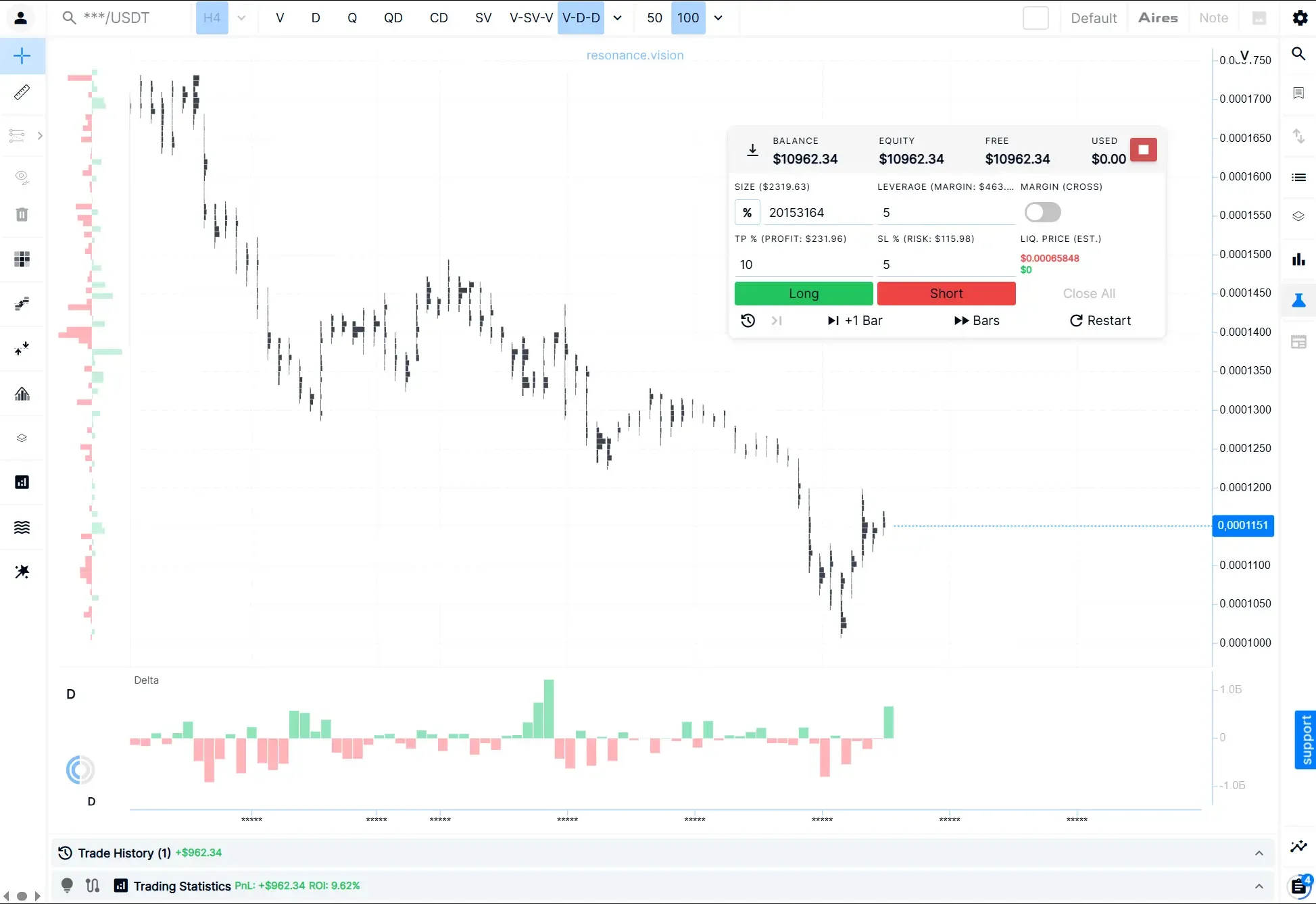
A crypto trading simulator is an environment for practicing trading decisions without risking real capital. In Resonance Trading Simulator, you use a virtual balance on real historical market data: you can open and manage positions, control risk, and see the financial outcome of your decisions, but no real orders are sent to an exchange.
At the same time, future price action is hidden. You enter the market at a specific point in the past and move forward gradually, receiving new market information only after the previous decision has already been made.
This combines two important elements of trading practice:
- simulated trading with virtual funds — you can open long and short positions, choose position size, use leverage, set a stop-loss, and define a take-profit without putting your own money at risk;
- historical market replay with the future hidden — you have to make decisions without knowing where price will move next.
It is the combination of these two mechanics that makes this different from simply studying an old chart.
You are not looking at a move that has already happened and imagining what you might have done. You make the decision first, using only the information available at that moment, and see the outcome afterwards.
That is the core value of the exercise: repeatedly making trading decisions before you know what happens next.
Why Watching Historical Charts Is Not Enough
Historical charts are useful for studying market structure, trading patterns, and specific examples. The problem is simple: you already know how the story ends.
Imagine a historical chart with a clear breakout followed by a strong move.
Looking at it afterwards, everything can appear logical:
- the breakout looks convincing;
- the trend direction seems obvious;
- the pullback looks like a good entry;
- the reversal is easy to identify.
But at the moment the decision had to be made, those later candles did not exist yet.
In psychology, this is known as hindsight bias: once an outcome is known, people tend to see it as more predictable than it actually was.
In trading, the distinction is especially important.
A completed historical chart answers:
What happened?
A trader making a decision has to answer a different question:
What should I do with the information available right now?
Those are not the same task.
You can study hundreds of successful historical setups and become good at recognizing them after the move has already developed. That does not necessarily mean it will be equally easy to recognize the situation, reject a weak entry, or manage a position when the next candle is still unknown.
Historical replay changes exactly that condition.
How Historical Market Replay Changes Trading Practice
In a properly structured historical simulation, information is revealed gradually — broadly in the same sequence in which it became available to the market originally.
The process looks like this:
historical starting point → future hidden → market analysis → decision → new bars → new information → outcome
You begin at a specific point in the past and see only the information that was available up to that moment.
First, you analyze the market situation.
Then you decide whether there is a valid reason to open a position.
If there is, you choose the direction, position size, and risk.
Only then does the market move forward.
New information appears after the previous decision has already been made.
The difference may sound small. In practice, it changes the nature of the exercise.
Suppose price approaches an area of visible limit-order resistance.
On a completed historical chart, you can already see that price eventually broke through the level — or reversed from it — and then made a strong move.
In the simulator, you do not know that yet.
The market could:
- break through the resistance and continue higher;
- produce a false breakout and move back below the level;
- reject the area of limit-order resistance;
- remain range-bound;
- change direction several times before a clearer move develops.
Your task is not to find the correct answer on a completed chart.
It is to make a decision while the future move is still unknown.
That is the main value of historical market replay as a trading practice tool.
What Can You Practice in a Trading Simulator?
Useful simulation should involve more than finding an entry.
Every trade is a sequence of decisions. That entire sequence can be practiced.
Entry Decisions
You can define in advance what conditions must be present before a trade is allowed.
During the simulation, the task is no longer to find an attractive entry in hindsight. Instead, you have to answer a specific question:
Does the current situation meet my rules right now?
Choosing Long or Short
Historical scenarios let you practice both long and short situations without waiting for a particular market condition to appear in the live market.
Choosing not to trade is also a decision.
If your entry conditions are not present, the correct action may be to stay out entirely.
Position Size
A good trading idea does not automatically determine how much capital should be allocated to it.
A simulator lets you practice position sizing separately and see whether your risk remains consistent from one trade to the next.
Defining the Stop-Loss
Before the trade develops, you can define the level at which the original idea is no longer valid — your stop-loss.
That is fundamentally different from deciding where to exit only after the market has already shown you which direction it is moving.
Setting a Profit Target
You can also define a take-profit level before the trade develops, then compare the original plan with the actual outcome afterwards.
Leverage and Risk Management
Leverage is available in the simulator and can be treated as part of the risk-management process rather than simply a way to increase position size.
A mistake does not cost real money, but its consequences are still visible in the simulated result.
Position Management
Once a position is open, a new series of decisions begins.
Are you following the original plan?
Are you closing profitable positions too early?
Are you increasing the amount you are prepared to lose after entering?
Has new market information genuinely changed the setup — or has waiting simply become uncomfortable?
This is often where the difference between knowing a trading rule and following it consistently becomes visible.
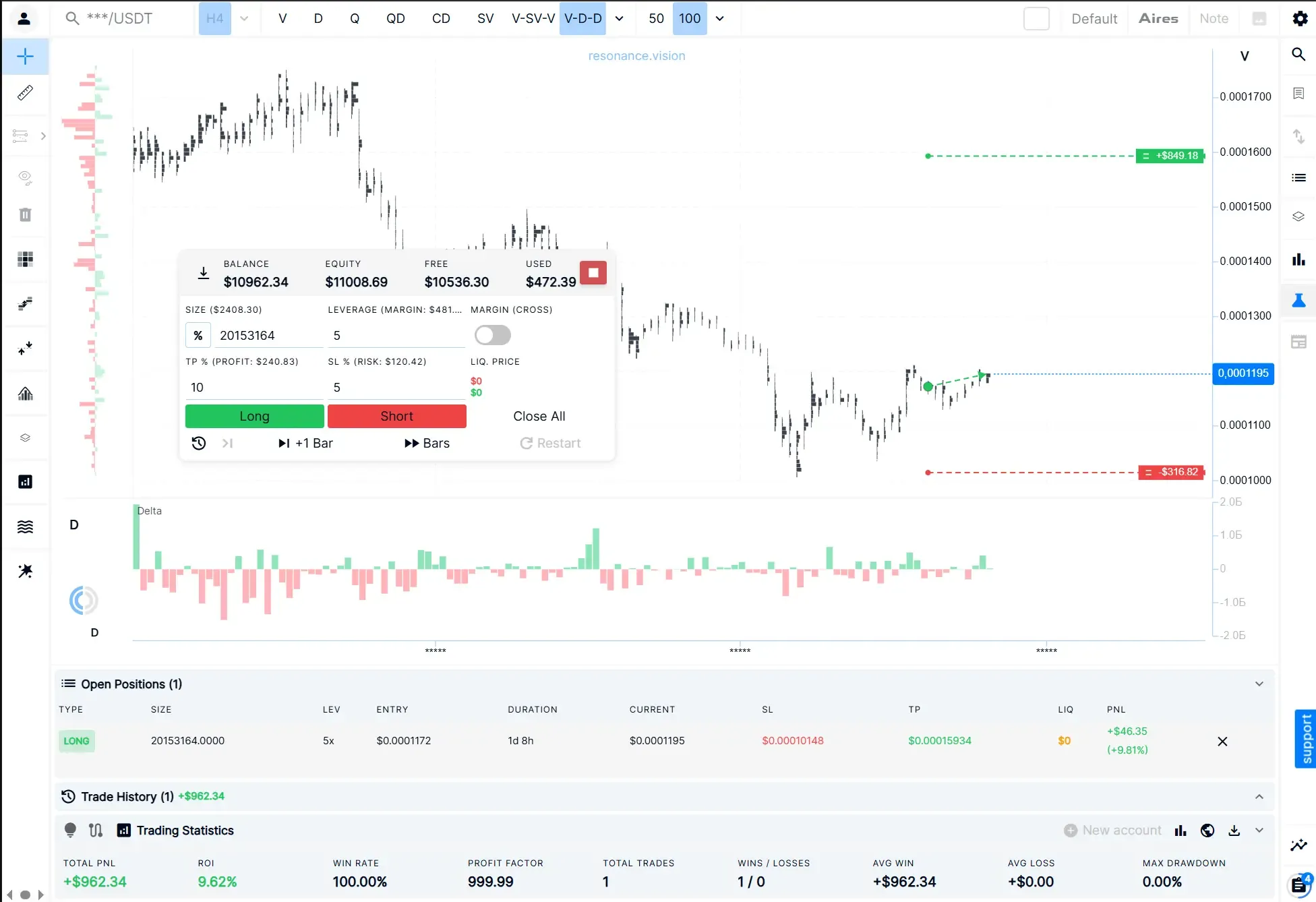
Following a Trading Plan
One of the most useful ways to work with a simulator is to define the rules before the scenario begins.
For example:
- what conditions allow an entry;
- how much risk is acceptable;
- where the stop-loss should be;
- under what conditions the trade should be closed;
- what must not be changed after the position is opened.
After the session, you can compare the plan with what you actually did.
Post-Session Review
The final profit or loss is only part of the result.
A useful review can ask:
- How many decisions followed the plan?
- Were losses caused by the trading idea itself or by execution mistakes?
- Was risk consistent from trade to trade?
- Were profitable positions repeatedly closed before the planned target?
- Did long and short trades produce different results?
- Did the overall result depend on one unusually large winning trade?
The question then changes.
Instead of asking:
“Was this trade profitable?”
you begin asking:
“What does this series of decisions tell me about my trading process?”
Live Paper Trading vs Historical Replay: What’s the Difference?
Live paper trading and historical replay are useful to distinguish because they create different practice conditions.
Resonance does not separate these into a live paper-trading mode and a historical mode. Instead, it combines the simulated-position mechanics associated with paper trading — virtual funds, long and short positions, position sizing and risk management — with historical market replay.
The general distinction is still useful:
| Live Paper Trading | Historical Replay | |
|---|---|---|
| Market data | Current market | Real historical market data |
| How time moves | At normal market speed | Controlled by the replay |
| Future price action | Unfolds naturally in real time | Hidden until the simulation moves forward |
| Available scenarios | Whatever the market is doing now | Different periods of market history |
| Practice pace | Limited by real-time market movement | More situations can be practiced in less time |
| Useful for | Practicing interaction with current market conditions | Repeated decision practice across historical scenarios |
| Main limitation | Building a large sample takes time | Historical conditions and simulated execution are not live trading |
If your goal is to repeat the cycle of analysis → decision → new information → review across many different market situations, historical replay makes that process much easier to repeat.
What a Simulator Cannot Reproduce
The absence of real financial risk is one of the main advantages of simulation for practice. It is also one of its limitations.
A simulator is not a complete reproduction of live trading.
Real Financial Consequences
A loss in the simulator reduces a virtual balance.
A loss in live trading means losing actual money.
Your reaction to the same market situation may therefore be different. Simulated results cannot fully reproduce the behavioral effect of real financial risk.
Slippage and Liquidity
In live trading, the actual execution price may differ from the price you expected.
This can become especially important during sharp price movements or in low-liquidity conditions.
Simulation cannot always reproduce these conditions completely.
Real-Market Context
The historical data is real, but you are still working with the past.
Your current knowledge, the information available to you today, and the way you interpret the situation may differ from what was available when that market move originally happened.
Future Performance
A strong result in simulation does not mean the same strategy will produce the same result in the future.
Historical practice can show how your rules and decisions behaved across a particular sample of past market situations.
It does not turn historical results into a forecast.
So after a simulation, a more useful question is not:
“Did I prove that this strategy works?”
but:
“What did this series of decisions reveal about the way I trade?”
How Resonance Approaches Trading Practice
Resonance Trading Simulator is built around decision practice on real historical market data with future price action hidden.
You see only the part of the chart that has already “happened” at the current point in the simulation. The asset name, date, and time are also hidden, reducing clues that could reveal where you are in market history.
From there, time moves forward and new bars are revealed gradually.
You can open long and short positions, choose position size, use leverage, set a stop-loss, and define a take-profit. Everything happens on a virtual balance, so no real capital is used.
Random simulations place you into a historical scenario that you did not select in advance.
This matters because when traders choose their own “good examples,” they naturally tend to select situations that already look clear or familiar. Random scenarios reduce the opportunity for that kind of selection, although they cannot eliminate every possible source of bias.
The purpose of the Simulator is not to tell you which trade to take.
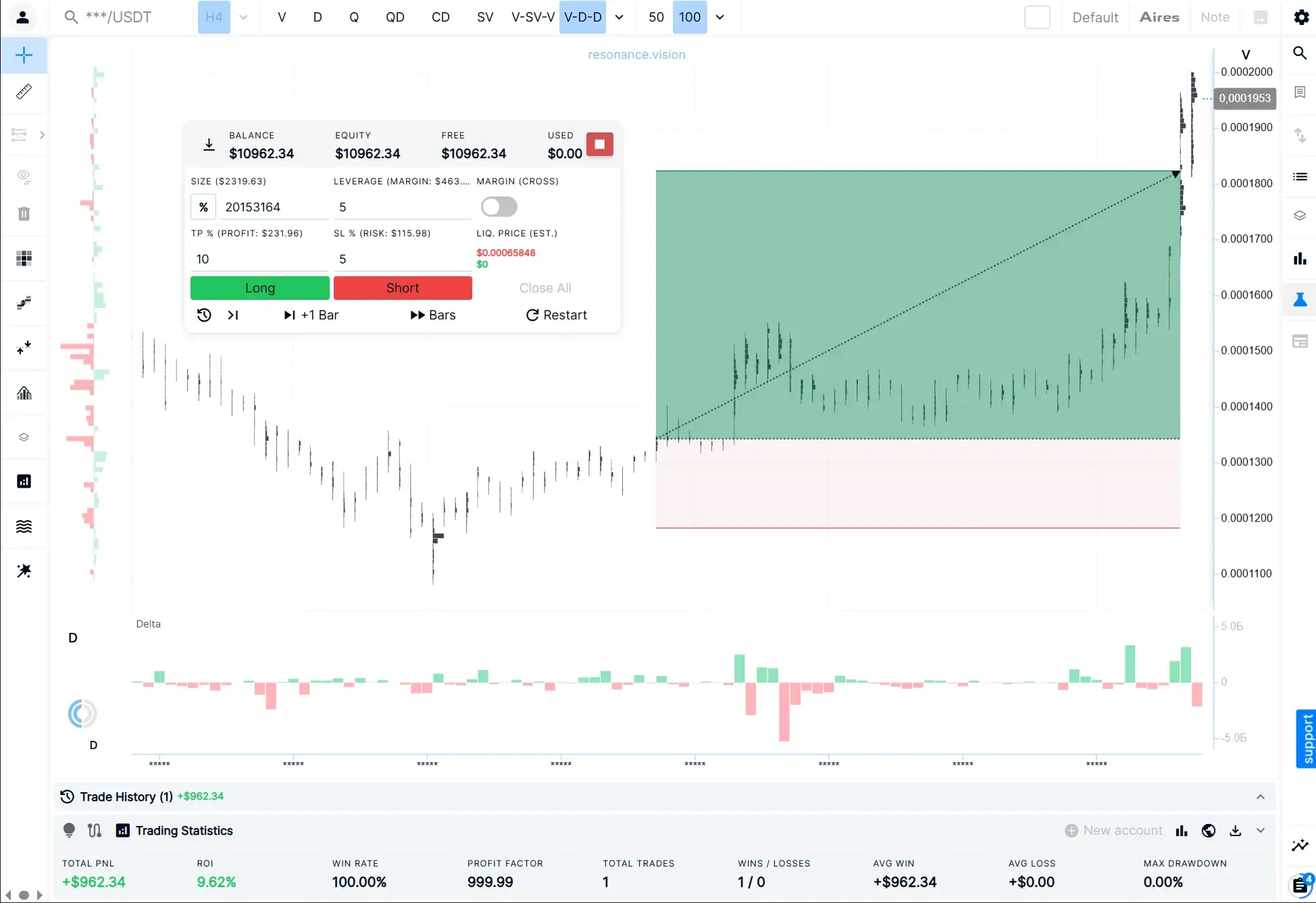
Its logic is different:
analyze the market → make a decision → manage the position → see the outcome → review your actions
After the session, you can review trading statistics and the history of closed trades. This makes it possible to evaluate the sequence of decisions rather than judging your practice by the last position alone.
Depending on the simulation mode and available tools, the chart can also provide additional context about market structure and trade flow. These tools provide information; they do not make the trading decision for you.
From Practice to Performance Review
A simulator becomes more useful when individual sessions form a repeatable process.
For example:
define the plan → make the decision → see the outcome → review your actions → identify recurring mistakes → test yourself again
One profitable trade tells you only that one specific scenario ended in profit.
One losing trade tells you only that one scenario ended in a loss.
Neither individual outcome describes the quality of the entire trading process.
Once you build a sample of decisions, patterns become easier to see.
For example:
- entries follow the rules, but exits remain inconsistent;
- position size changes after several losses;
- long and short trades produce very different results;
- the overall result looks positive only because of one unusually large winner;
- planned risk and realized risk repeatedly diverge.
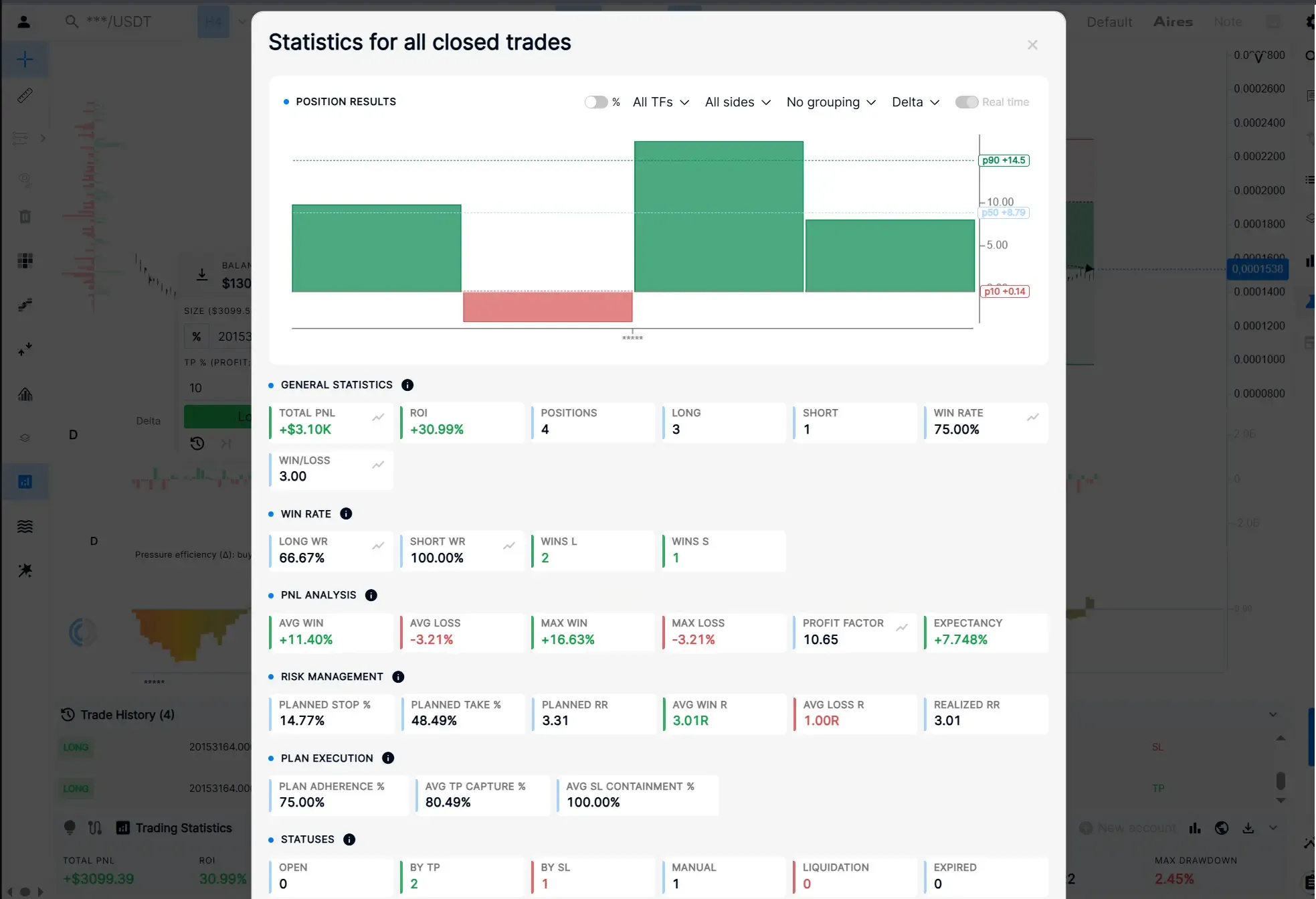
You need more than one trade to identify patterns like these. You need a sample of decisions and a way to review them.
That is why performance analysis is the natural next step after practice itself.
Simulation does not remove uncertainty from trading.
Its value lies somewhere else: it lets you practice inside that uncertainty before real capital is attached to the decision.
Practice on real historical market data with Resonance Trading Simulator.
Frequently Asked Questions
Can I Practice Crypto Trading Without Real Money?
Yes. A crypto trading simulator uses virtual funds and simulated positions, so no real capital is committed to the trades.
However, the absence of real financial consequences also means simulation cannot fully reproduce trader behavior or all conditions of live execution.
Is a Crypto Trading Simulator the Same as Paper Trading?
Not always.
Live paper trading generally uses virtual funds while the current market develops in real time.
A historical crypto trading simulator places you at a point in past market data and reveals subsequent bars gradually, without showing future price action in advance.
Resonance combines virtual-fund simulated trading with historical replay rather than running a separate live paper-trading environment.
What Is a Historical Crypto Trading Simulator?
A historical crypto trading simulator is an environment where you start at a point in real historical market data and make trading decisions as subsequent bars are gradually revealed.
In Resonance, future price action, the asset name, and the date and time are hidden, so the decision has to be made before the outcome becomes known.
Can a Trading Simulator Prove That a Strategy Is Profitable?
No.
Historical simulation shows which rules and decisions were applied to a particular sample of past market situations and what results they produced.
It does not guarantee future performance and cannot fully reproduce live execution, liquidity, slippage, or the effects of real financial risk.
What Should I Practice in a Trading Simulator?
Not just entries. Practice the entire decision process:
- selecting the market situation;
- choosing long or short;
- position sizing;
- defining acceptable risk;
- setting a stop-loss;
- setting a take-profit;
- managing the position;
- deciding when to exit;
- reviewing results after the session.
Recommended articles