How to Build Trading Experience Before Risking Real Money

How can you gain crypto trading experience without risking real money? Discover how to move from theory to practice, make independent trading decisions and learn from your mistakes.
Table of contents
- 01Understanding Trading Principles Is Not the Same as Applying Them
- 02Trading Experience Develops Through Repeated Decisions
- 03Why You Don't Need to Start Practising With Real Capital
- 04Build Your Trading Practice Step by Step
- 05Why Random Market Scenarios Help With Independent Practice
- 06Practise the Entire Trading Decision, Not Just the Entry
- 07What Trading Simulation Cannot Fully Teach You
- 08Moving From Guided Examples to Independent Practice With Resonance
- 09When Trading Practice Starts Delivering Real Value
- 10Frequently Asked Questions
- 11How Can I Build Crypto Trading Experience Without Using Real Money?
- 12Is Learning Trading Theory Enough Before Trading With Real Money?
- 13Why Should I Use a Trading Simulator?
- 14Why Are Random Market Scenarios Better Than Hand-Picked Examples?
- 15What Should I Practise Besides Finding Entry Points?
- 16Does Performing Well in a Simulator Mean I'm Ready for Live Trading?

You can have a solid grasp of trading terminology, understand risk management principles and recognise familiar setups on historical charts — yet still feel uncertain when you have to make a trading decision on your own, without knowing where the price will go next.
That is natural. Knowledge and practical skills develop in different ways.
Building trading experience takes more than reading articles, watching trade breakdowns or memorising rules. You need repeated opportunities to face uncertainty, make decisions, see how they turn out and examine what worked and what needs to change.
You don’t need real money to do that. Especially in the early stages, what matters more is creating an environment where you can focus on your decisions and practise repeatedly without facing financial consequences for every mistake.
Understanding Trading Principles Is Not the Same as Applying Them
Educational materials typically present carefully selected trading ideas that have already been explained and structured. They make the key principles of a trading approach easy to follow: here’s the signal to look for, here’s an example, and here’s the right sequence of steps.
When you watch a breakdown like this, the logic can seem perfectly clear.
Trading independently presents a different challenge.
You’re faced with a market situation, new information keeps coming in, and nobody tells you what to do — or whether you should act at all.
You have to assess the conditions yourself, consider the likely direction of the market, determine an acceptable level of risk, define your entry conditions, set a stop-loss and a target, and decide how to respond if the situation changes.
This is often where the difference between knowledge and practical skill becomes apparent. Some concepts are easy to explain when looking at completed examples but much harder to apply when a decision has to be made in the moment.
You might understand the importance of limiting risk but still increase it when faced with a particular market situation. You might know your exit rules yet repeatedly close profitable positions much earlier than planned. Or you might easily recognise a market setup after the move has finished but fail to spot it when the decision actually needs to be made.
Another round of theory alone won’t resolve these issues. What you need is practice.
Trading Experience Develops Through Repeated Decisions
Completing an exercise correctly once isn’t enough to build a reliable skill.
The real value of practice emerges when you repeat the same decision-making process across different market situations: observe the conditions, assess them independently, make a decision, see the outcome and review what happened.
Over time, this process reveals things that are difficult to notice through passive learning.
For example, you may discover that you’re good at identifying potential entries but consistently struggle with position sizing. Or that after several unsuccessful trades, you start deviating from your own rules. Or that the same mistake keeps appearing across different market conditions.
These observations give you something specific to work on in your next practice session.
Trading experience, then, isn’t simply a matter of how many hours you spend looking at charts. What matters is what you actually do during those hours and whether you have opportunities to evaluate your decisions.
Research into how people develop complex skills across different fields also distinguishes between simply repeating an activity and deliberate practice, which involves a specific task, feedback on performance and adjustments based on the results.
This doesn’t provide a formula for trading success. But it helps explain why passively watching the market is no substitute for making your own decisions.

Why You Don’t Need to Start Practising With Real Capital
Live trading adds financial consequences to every decision.
Those consequences are an important aspect of real-world trading, but during the learning process, they can make it harder to assess the particular skill you’re trying to develop.
Imagine you’re testing a trading rule that’s new to you, and your very first trade ends in a loss.
If real money was involved, you might immediately feel the urge to abandon the exercise, stop testing the rule or change your entire approach.
Yet a single outcome doesn’t tell you whether the problem was with the rule itself, how you applied it or simply the particular market conditions.
The opposite can happen, too.
Someone might break their own trading plan, take more risk than intended and happen to make a profit. If they focus solely on the financial outcome, that trade can easily feel like confirmation that they made the right decisions.
This is why separating learning from financial outcomes can be particularly useful in the early stages.
In a dedicated practice environment, you can concentrate on whether a decision was justified, whether the risk matched your plan, how you managed the position and what you should examine next time.
That doesn’t make simulated trading a complete substitute for live trading. It serves a different purpose.
Build Your Trading Practice Step by Step
If you’ve just learned a new concept, opening a random chart and telling yourself, “Now trade,” may not be particularly useful.
The task is too broad. You may not know exactly what to focus on or what to evaluate afterwards.
A more effective approach is to develop your practice progressively.
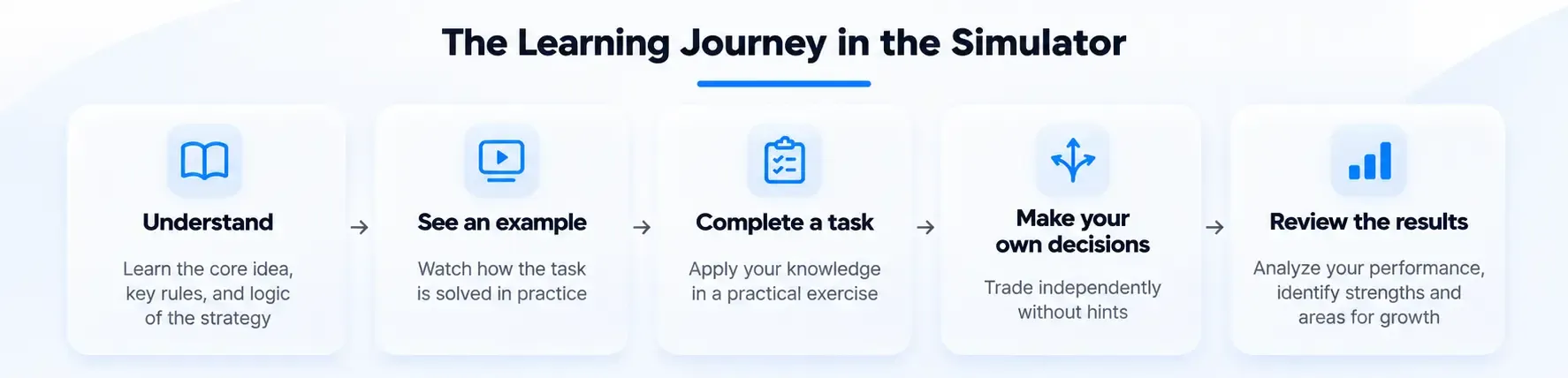
- Start by understanding the concept. You need to know which signal, pattern or principle you’re trying to apply and why it matters.
- Study a few worked examples. This helps you see how a theoretical rule applies to an actual market situation.
- Complete an exercise with a specific objective. Instead of simply trying to “open a trade,” you might practise defining your risk before entry, identifying the conditions that would invalidate your trade idea or managing an open position.
- Move on to independent decisions without hints. At this stage, you have to determine for yourself whether there’s a reason to act and how to execute your plan.
- Review a series of outcomes. A single successful or unsuccessful attempt tells you very little. Across a series of decisions, recurring patterns in your behaviour become easier to identify.
- Choose a specific weakness to address in your next session. If your review shows that you regularly increase risk after entering a position or close profitable trades too early, you can focus your next round of practice on that particular issue.
This progression doesn’t mean you have to complete each stage once and never return to it.
You can revisit the theory after practising. You can study more examples after making independent decisions. And when you identify a particular weakness, you can design another exercise to address it.
Learning is better understood as a continuous cycle, with each round of practice becoming more focused based on what you’ve discovered.
Why Random Market Scenarios Help With Independent Practice
When you choose your own charts for trading practice, your existing knowledge can influence what you select.
You might pick a familiar asset, remember a major historical price move or simply choose a section of the chart that looks easy to interpret.
Sometimes this happens deliberately. Sometimes it doesn’t.
Practising on hand-picked charts can still be useful, but it’s less effective at testing your ability to respond to market situations you haven’t chosen yourself.
Randomly selected historical scenarios reduce the opportunity to pick convenient examples. You’re presented with conditions you didn’t select, and you have to work with the information available.
This doesn’t eliminate every possible bias or make each simulation an entirely objective test.
But it brings the exercise closer to a fundamental trading challenge: assessing the information available at the time without knowing the outcome in advance.
For a closer look at why an unfinished historical market scenario differs from analysing a completed chart, read Crypto Market Replay: Why Historical Chart Analysis Is Not the Same as Trading It.
Practise the Entire Trading Decision, Not Just the Entry
A large amount of trading education focuses on finding entry points.
Where should you buy? Where should you sell? Which signal should you use?
But even a well-timed entry is only one part of a trade.
Before opening a position, you need to decide how much risk you’re willing to take and what position size is appropriate for that risk.
You also need to understand what would invalidate your original trade idea and where you would exit if the market moved against your expectations.
Once the position is open, new decisions arise.
Should you stick to your original plan? How should you respond as market conditions develop? When should you take profits or close the trade? Is there a valid reason to adjust your position management before the planned exit?
And after the trade is closed, you need to review it.
Which decisions were sound? Where could you have made a better choice? And, importantly, was there enough information available at the time to justify that alternative?
If you only practise identifying entries, all these other parts of trading remain untested.
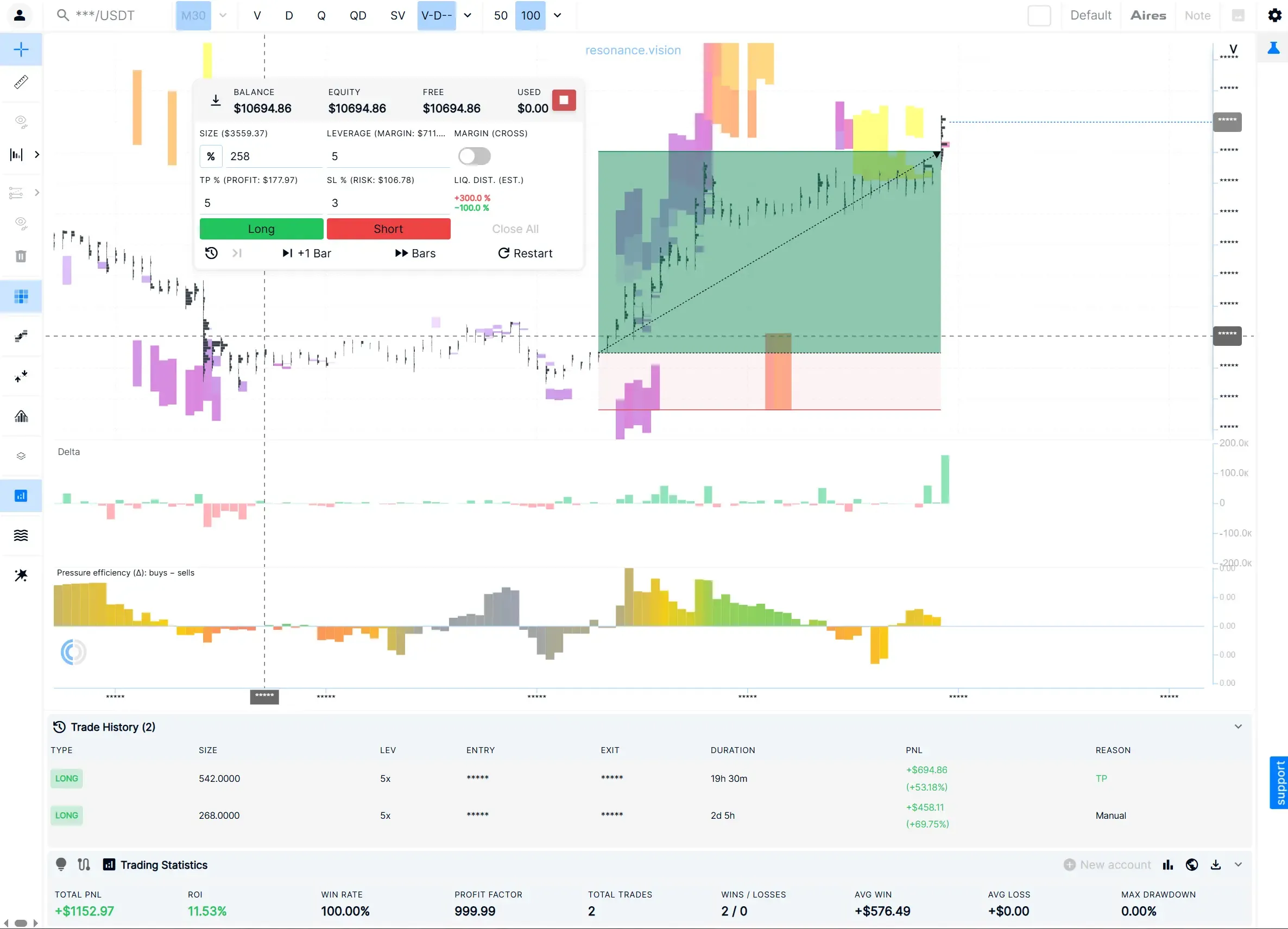
A complete trading exercise should therefore cover the entire decision-making process: assessing the market, planning the trade, defining risk, opening the position, managing it, closing it and reviewing the result.
What Trading Simulation Cannot Fully Teach You
Practising without real money has an obvious advantage: mistakes don’t lead to actual financial losses.
But that same advantage also creates a limitation.
Without real money at stake, you don’t experience the same financial pressure.
You might follow your trading plan calmly in a simulation but behave differently when every price movement has a direct impact on your own money and state of mind.
You also shouldn’t assume that a trading simulator fully reproduces every aspect of order execution on a live exchange.
For these reasons, strong results in a simulated environment don’t prove that you’ll achieve the same results in live trading.
Simulation serves a different purpose.
It allows you to practise making decisions repeatedly, evaluate how consistently you follow your process and identify recurring mistakes without having to pay for every learning experience with real money.
It’s a valuable stage of preparation, but it isn’t a certificate of readiness for live trading.
Moving From Guided Examples to Independent Practice With Resonance
Resonance allows you to work through this learning progression step by step.
You can begin with worked examples and guided exercises that include explanations and give you an opportunity to review your decisions afterwards.
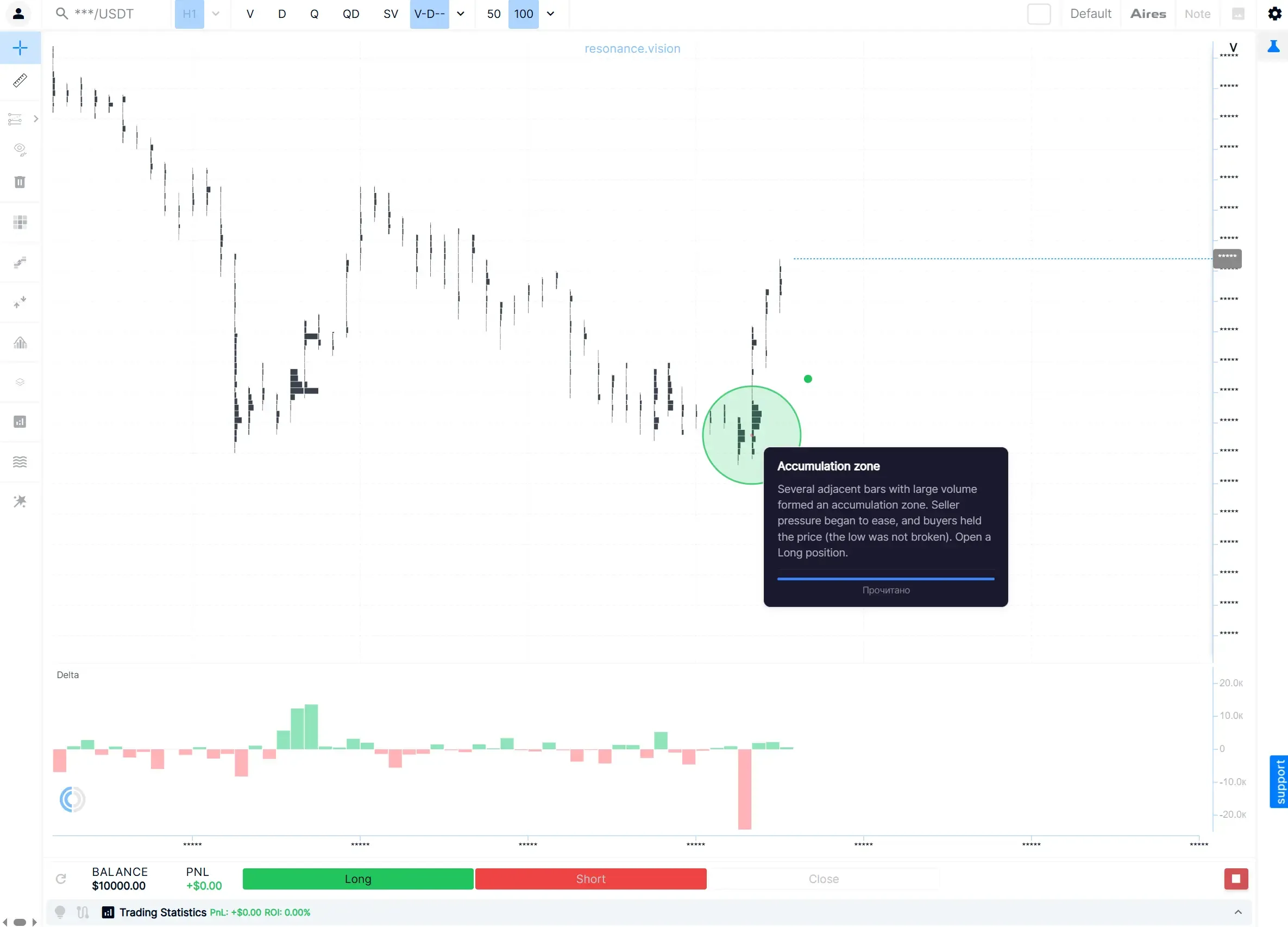
These scenarios aren’t designed simply to show you the “perfect trade.” Their purpose is to provide a clearly defined practice task.
Once you understand what you’re working on, you can move to independent simulation.
In this mode, market scenarios are selected at random, there are no hints, and future price action is revealed gradually as you progress through the historical chart.
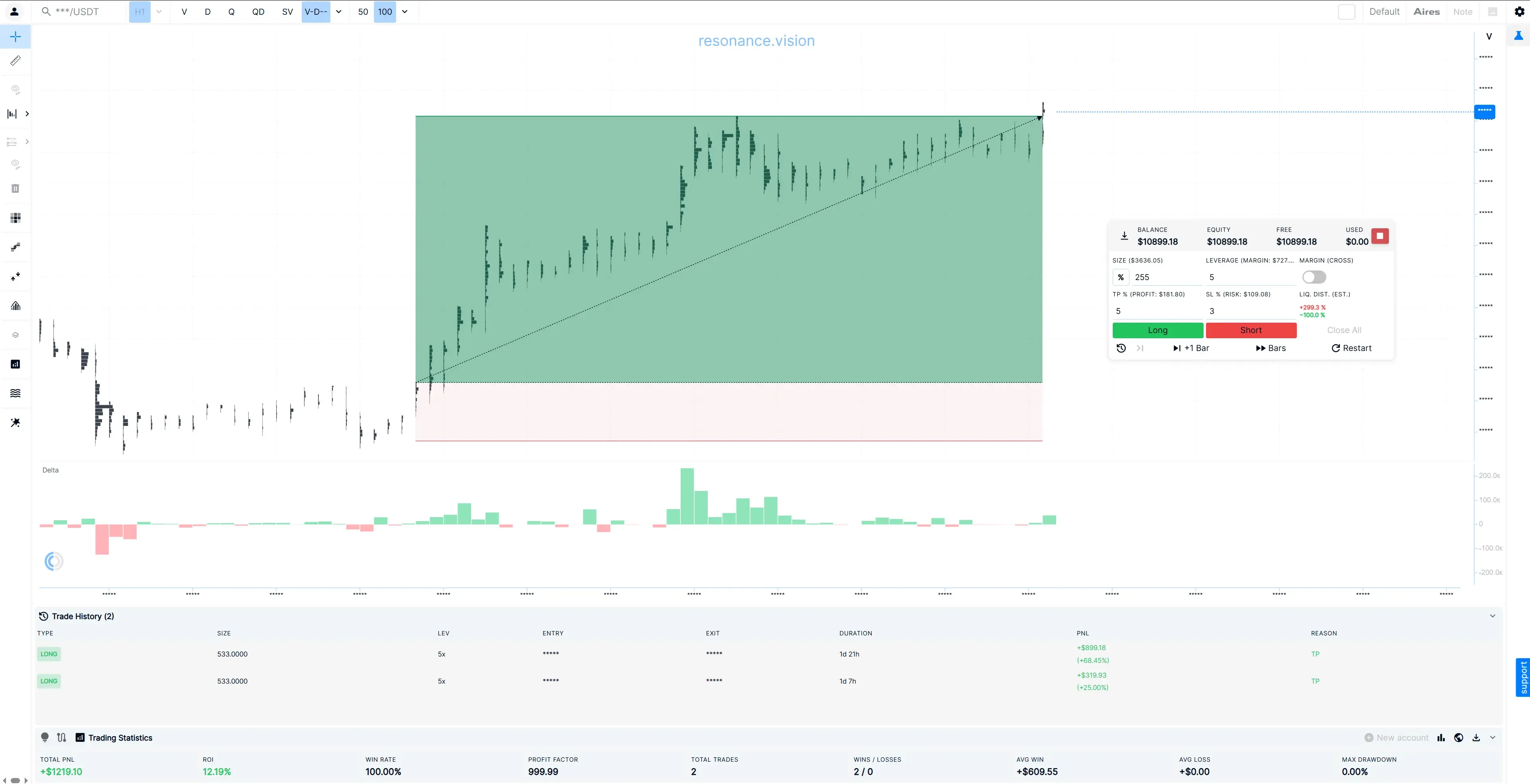
You have to make your own trading decisions, define your position parameters and work through the unfolding market scenario.
After the session, you can review your trading statistics and trade history, then return to individual decisions that deserve a closer look.
This approach turns the Simulator into more than a game with a virtual balance. It becomes an environment for structured trading practice.
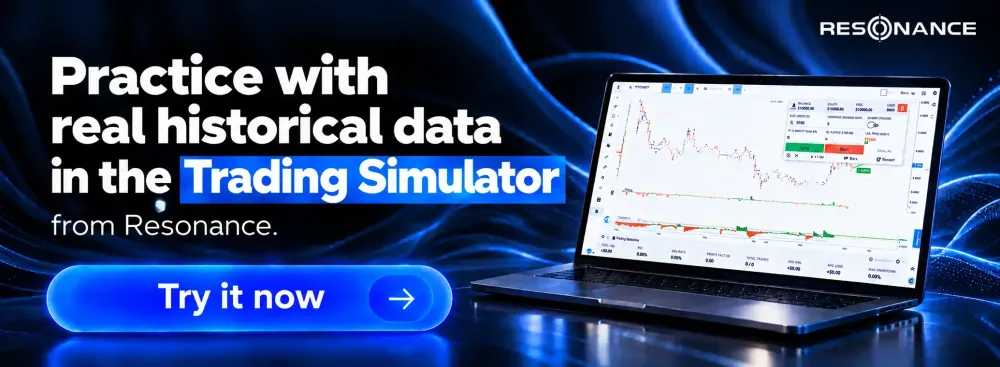
Practise making trading decisions on historical market data without seeing what happens next.
Explore Resonance Trading Simulator
When Trading Practice Starts Delivering Real Value
The goal of practice isn’t to complete as many simulations as possible or achieve the highest virtual profit.
What’s far more useful is being able to explain, after several sessions, which parts of your decision-making have become more consistent, where you’ve improved and which problems remain.
Perhaps you used to decide how much to risk only after entering a trade, but now you define it beforehand.
Or you’ve noticed that you’re most likely to break your trading plan after two consecutive losses.
Or you’ve discovered that you’re good at finding entry opportunities but struggle to follow your position management rules consistently.
These observations give you a clear direction for your next round of practice.
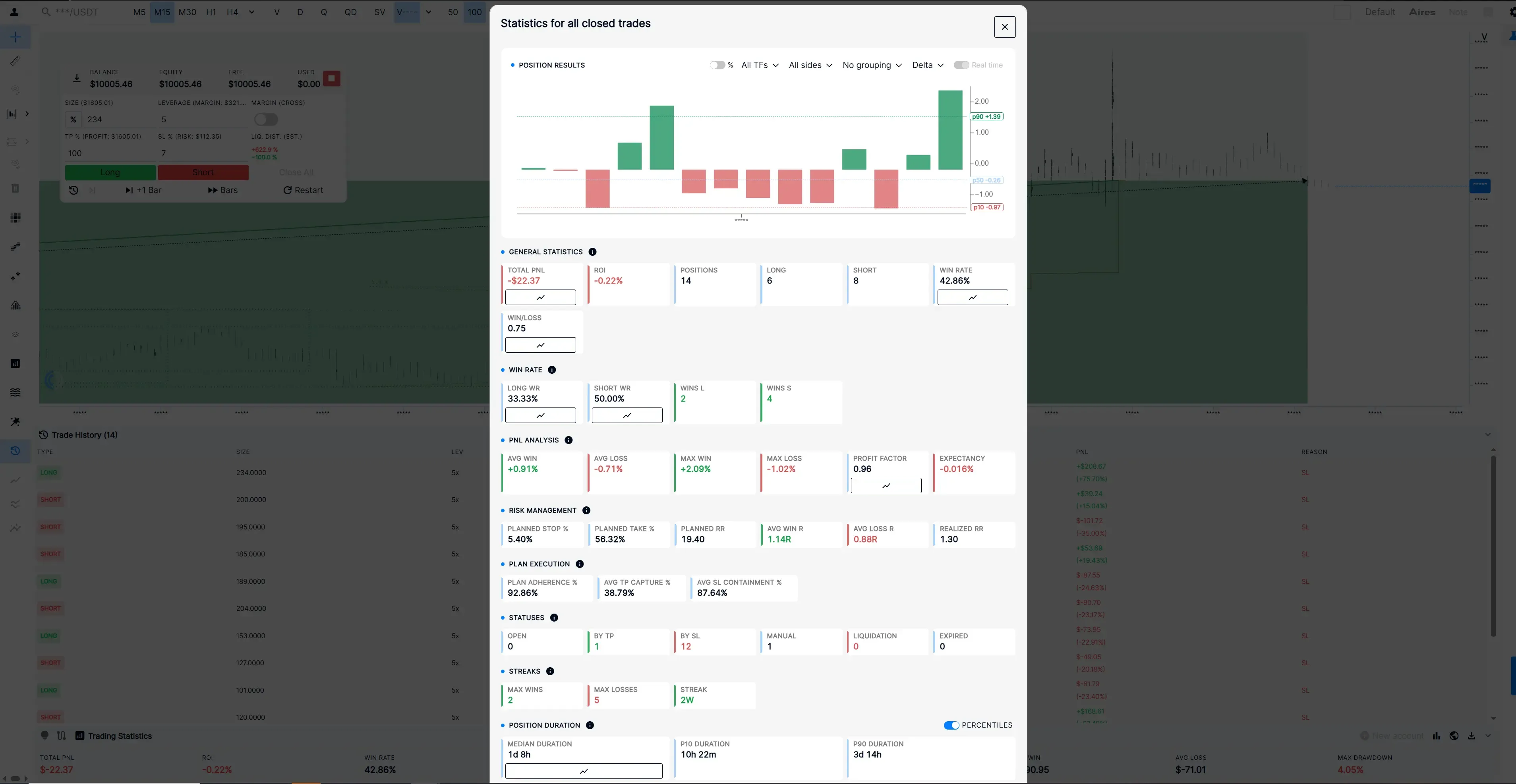
This is also where analysing a series of decisions becomes more valuable than focusing on a single trade.
For a detailed look at how to evaluate a sample of trades without judging your performance by the most recent result, read Trading Performance Analysis: Why One Trade Is Not Enough.
Trading experience doesn’t begin the moment you first put real money at risk.
It starts developing earlier, when you begin applying your knowledge independently, repeating decisions, analysing outcomes and using what you’ve learned to make your next practice session more effective.
Learn from examples, practise specific skills, move towards independent decision-making and use the results of each series of trades to make your next round of practice more focused and purposeful.
Frequently Asked Questions
How Can I Build Crypto Trading Experience Without Using Real Money?
Use a practice environment where you can make trading decisions independently without knowing future price movements, then review your actions and results afterwards.
Structured practice with a clear objective and a review process is more valuable than simply placing simulated trades at random.
Is Learning Trading Theory Enough Before Trading With Real Money?
Theory provides an essential foundation, but it doesn’t replace practical decision-making experience.
Understanding a rule and applying it independently in an uncertain market situation are two different skills.
Why Should I Use a Trading Simulator?
A trading simulator allows you to practise trading decisions repeatedly without real financial consequences.
This helps you focus on trade planning, risk management, position management and reviewing your own decisions.
Why Are Random Market Scenarios Better Than Hand-Picked Examples?
Random scenarios reduce the opportunity to deliberately select familiar or convenient market conditions.
This makes independent practice less dependent on the examples you would otherwise choose for yourself.
What Should I Practise Besides Finding Entry Points?
Practise the entire trading process: assessing market conditions, defining risk, choosing a position size, planning exits, managing an open trade, closing the position and reviewing the outcome.
Does Performing Well in a Simulator Mean I’m Ready for Live Trading?
No. Simulated trading doesn’t create the same financial pressure as live trading, and it may not fully reproduce real-world order execution.
Its purpose is to provide a structured environment for developing and reviewing trading decision-making skills.
🚀 Try Trading Simulator and turn market knowledge into practical experience.
🎁 Use promo code TOPBLOG to get 10% off any Resonance subscription plan.
📢 Follow new articles, market insights, and practical trading content in our Telegram channel.
🔗 Register with our partner exchanges:
Recommended articles