How a Trader Can Find an Entry and Exit Point In Crypto: The Art of Precise Timing
Entry and Exit Points in Trading: How to Determine the Ideal Timing in the Cryptocurrency Market
Table of contents
- 01The Main Mistake of Traders: Searching for the Perfect Signal
- 02Why the Market Does Not Give Exact Signals
- 03Where an Entry Point Appears
- 04How Price Movement Is Formed: Supply, Demand, and Imbalance
- 05Two Key Conditions for a Good Entry
- 06Timing in Trading: Searching for an Entry Point
- 07Main Exit Options
- 08Where to Place a Stop-Loss
- 09The Psychology of Timing in Trading
- 10Checklist for Determining an Entry and Exit Point
- 11Conclusion: Timing in Trading Is Not Guessing

Why Timing Matters a Lot
In trading, you can get the direction right — and still lose money.
The main reason is poor timing in crypto trading.
An asset may be rising, but most participants at that moment:
- buy where there is already supply
- do not understand where the movement may end
- set too tight a stop and get stopped out of the trade prematurely
A crypto trading entry point is never just a random click — it is a decision made in context.
It is the moment when the probability of movement begins to shift in your favor.
The same is true for the exit. Entry and exit points in crypto are always connected.
If the entry answers the question of where to open a position with an edge, then the exit shows where the trading idea stops working.
The Main Mistake of Traders: Searching for the Perfect Signal
Most traders start trading with the same thing: they try to find an ideal signal system for entry.
Usually this is:
- an indicator
- a pattern
- a combination of several conditions
The logic is simple: you want to determine a working scheme once and then simply repeat it on the market. So that the entry point in trading appears exactly at the moment of reversal, and the statistics always remain positive.
The problem is that both indicators and patterns and signals only work from time to time. They can deliver results only under certain conditions. And, for example, in another market phase — they stop working altogether. Today the tool looks strong, and tomorrow the same set of conditions no longer
provides an advantage.
The reason is simple: the market changes faster than any algorithms built only on price. Therefore, both in day trading and in a calmer medium-term trading, it is not enough to simply wait for the crossing of lines or a ready-made pattern. You need to understand what exactly is happening inside the movement.
Why the Market Does Not Give Exact Signals
The market is not a set of formulas and indicators.
The market is the interaction of buyers and sellers, where the price change is only the result of this process.
Simply put, price does not move by itself. Price charts show the result, but charts alone do not show who was really in control.First, actions of participants appear on the market, then the execution of orders, and only after that we see movement on the chart. Therefore, entry and exit points in crypto cannot be built only on indicator signals.
There is a simple fact: the market is people, and people do not act according to a formula. They are influenced by emotions, expectations, fear, greed, macroeconomic and geopolitical factors, liquidity, and context. That is why it is impossible to get a universal and precise signal system for every case.
If the task is to determine a strong entry point in trading, you need to analyze the behavior of participants: who is pressing with market orders, who is absorbing volume, and look at why the price is reacting exactly this way and not otherwise. This is especially important in such a volatile market as cryptocurrency, where movements often occur sharply. In this case, timing directly affects the result.

Where an Entry Point Appears
The best crypto trading entry point usually appears where imbalance is forming and the market starts to confirm it. An entry point in trading does not appear by chance. It appears where an imbalance of supply and demand is formed on the market.
Imbalance is a situation in which buyers or sellers press harder than the opposite side can hold.
Any movement begins not with an indicator and not with a pattern, but at the moment when one of the sides begins to gain an advantage.
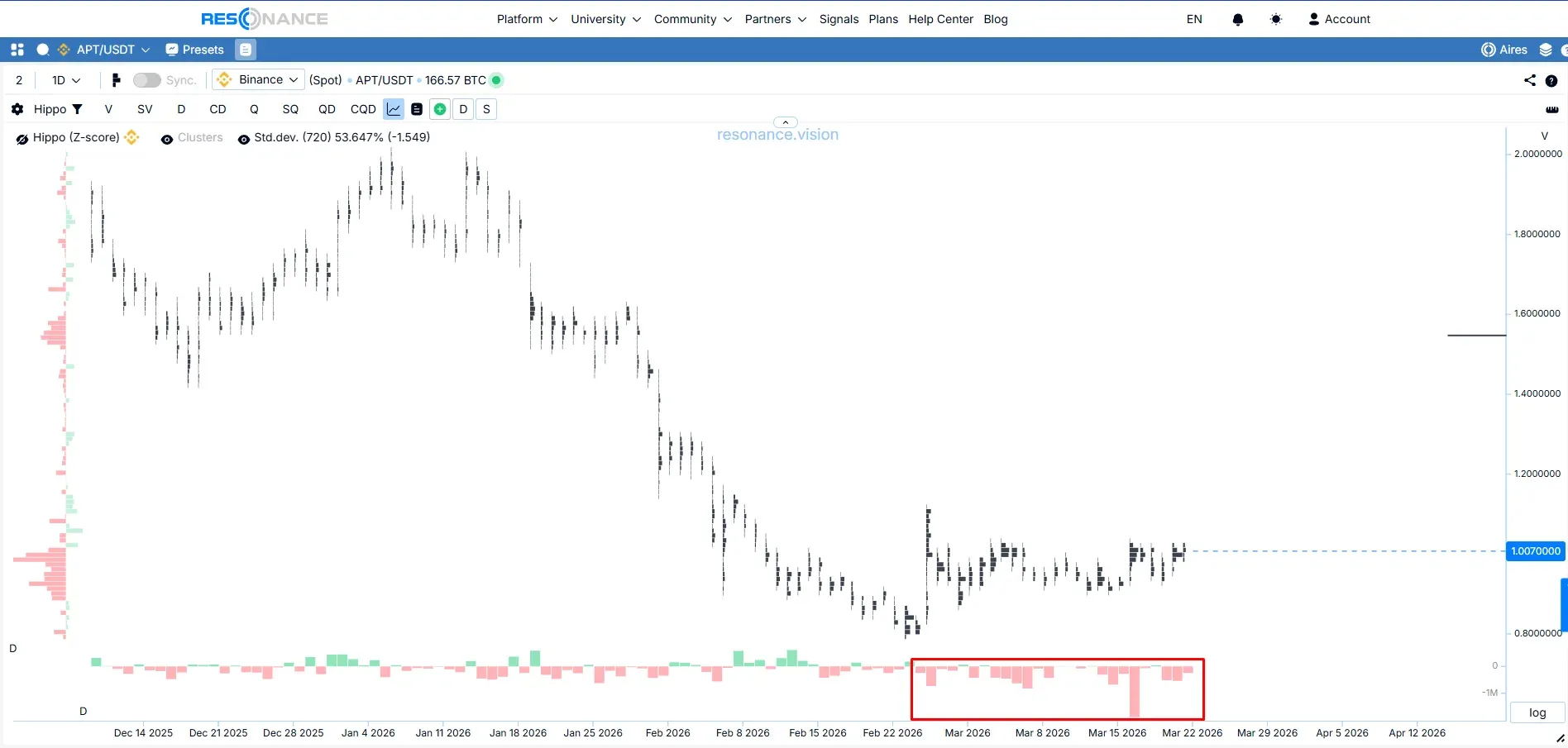
For example: a lot of sales (red rectangle) → the price does not fall → it means sales are being absorbed → it means there is demand → it means the probability of growth increases.
It is in such situations that the probability of an upward movement becomes higher.
This way, you can more easily determine an entry point in trading.
How Price Movement Is Formed: Supply, Demand, and Imbalance
At the core of any price movement in the market lies a simple principle — the law of supply and demand.
Price does not rise or fall by itself. It changes as a result of participants’ actions: if demand is stronger than supply, the price goes up. And vice versa.
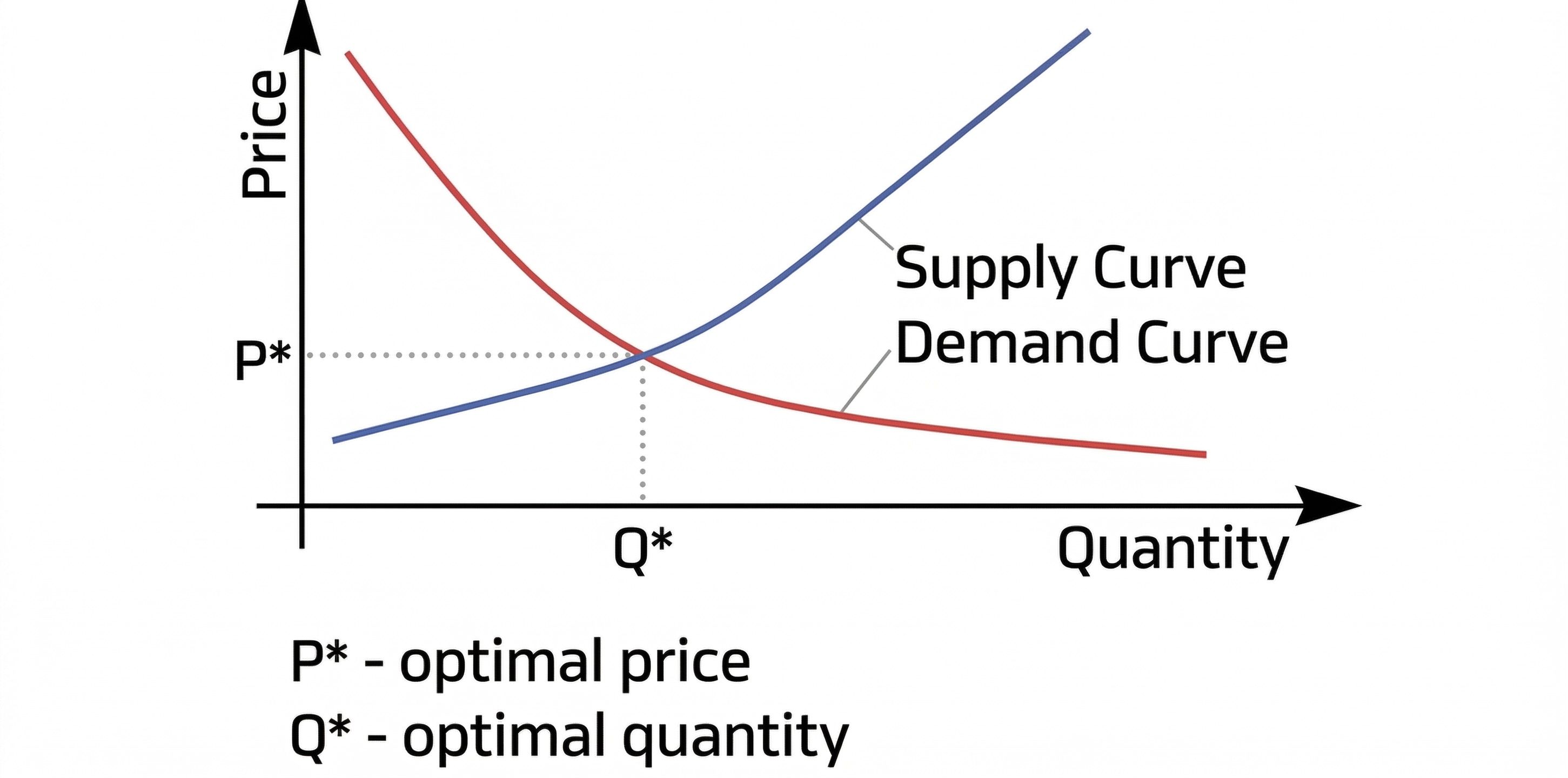
But in real trading, everything is not so primitive. On the chart, we see not an abstract balance, but a constant struggle between buyers and sellers. One side tries to push through its volume, the other — to absorb it and hold the price. It is from this conflict that movement is born. That is why traders compare cluster charts, and liquidity charts instead of relying on one view.
Therefore, for a trader, it is important not just to look at the price, but to determine which side of the market is really stronger now. This is where the understanding of how to find not a random trade, but a moment in which an advantage appears, begins.
In practice, the imbalance of supply and demand usually manifests in two states: deficit and surplus.
Deficit occurs when demand exceeds supply. This is visible in the price reaction to volume:
- market purchases move the price up
- sales do not cause noticeable decline
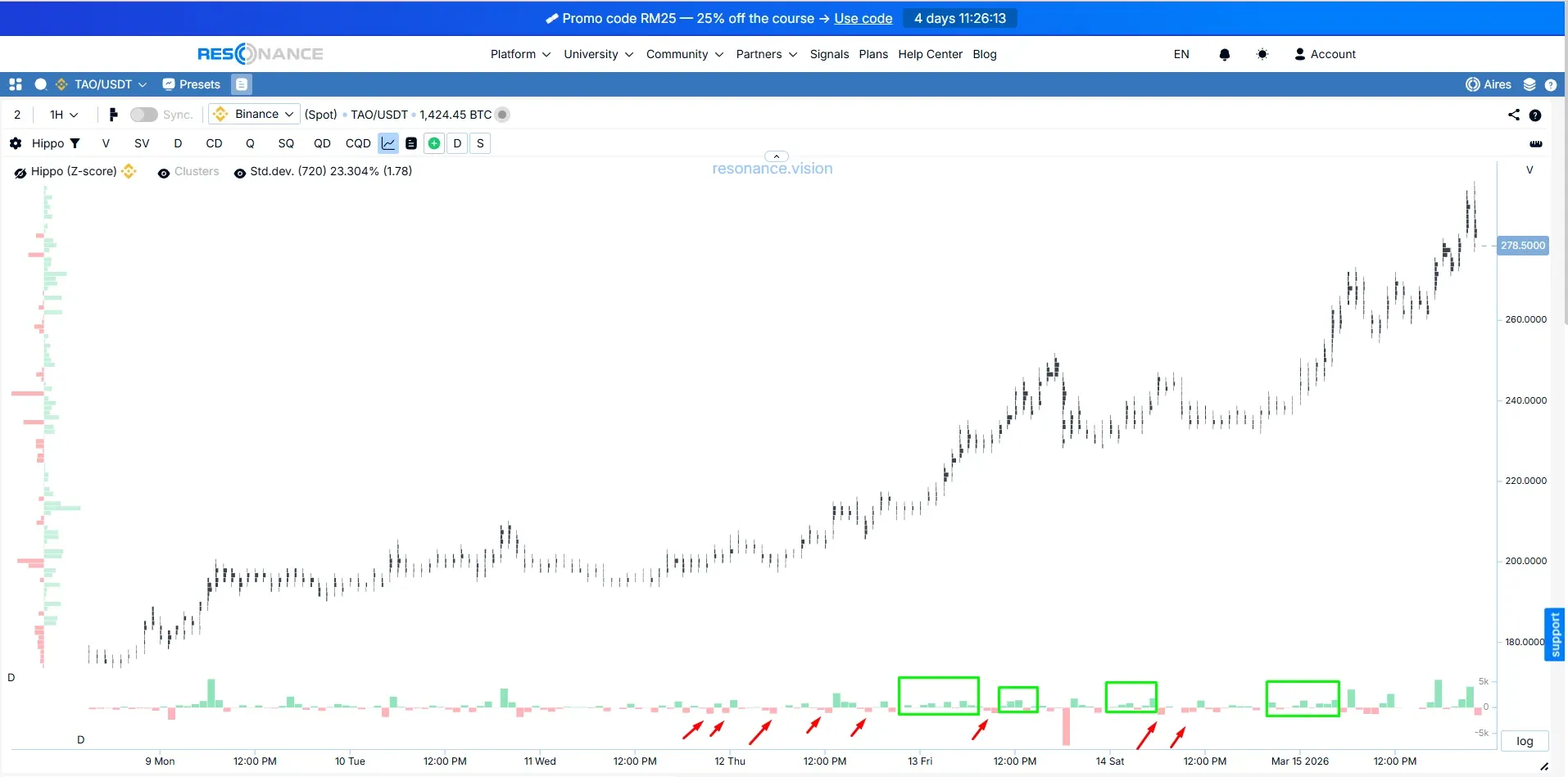
This means that counter supply is being absorbed, and the buyer controls the situation. In such conditions, the probability of continued growth becomes higher.
Surplus, on the contrary, appears when supply is stronger than demand:
- purchases do not cause growth
- sales move the price down
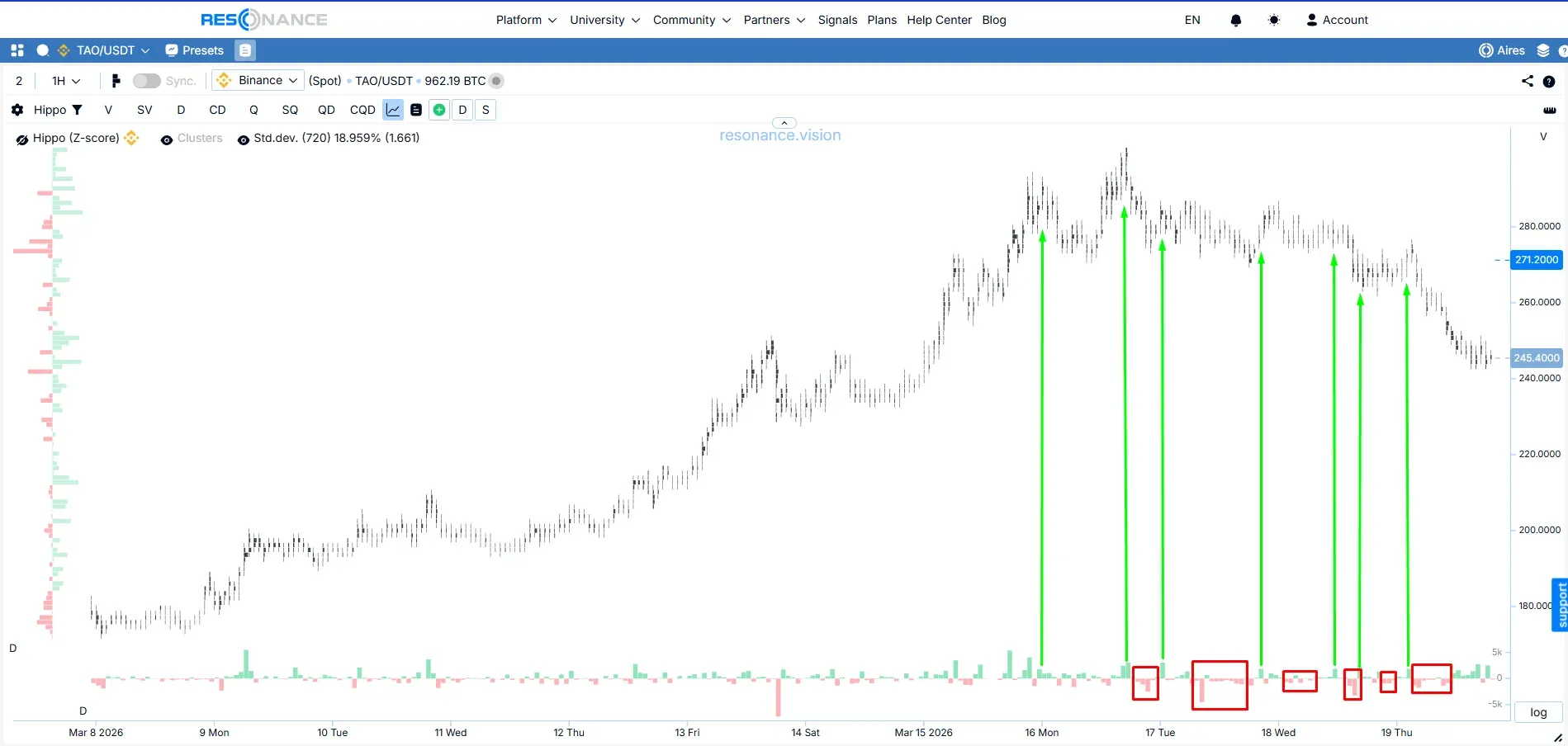
This already indicates the dominance of the seller. In such a situation, the probability of decline becomes higher, and entry and exit points need to be found taking into account the pressure from the supply side.
The key point here is one: it is not the volume itself that matters, but the price reaction to this volume.
It is through this reaction that you can understand who currently has the advantage. Volume is money. And that means it is with their money that participants move the market.
From the point of view of the interaction of supply and demand, price movement can be considered as a sequence of phases:
1st phase – formation of deficit → 2nd phase – realization of the state → 3rd phase – consolidation (surplus) → 4th phase – search for balance
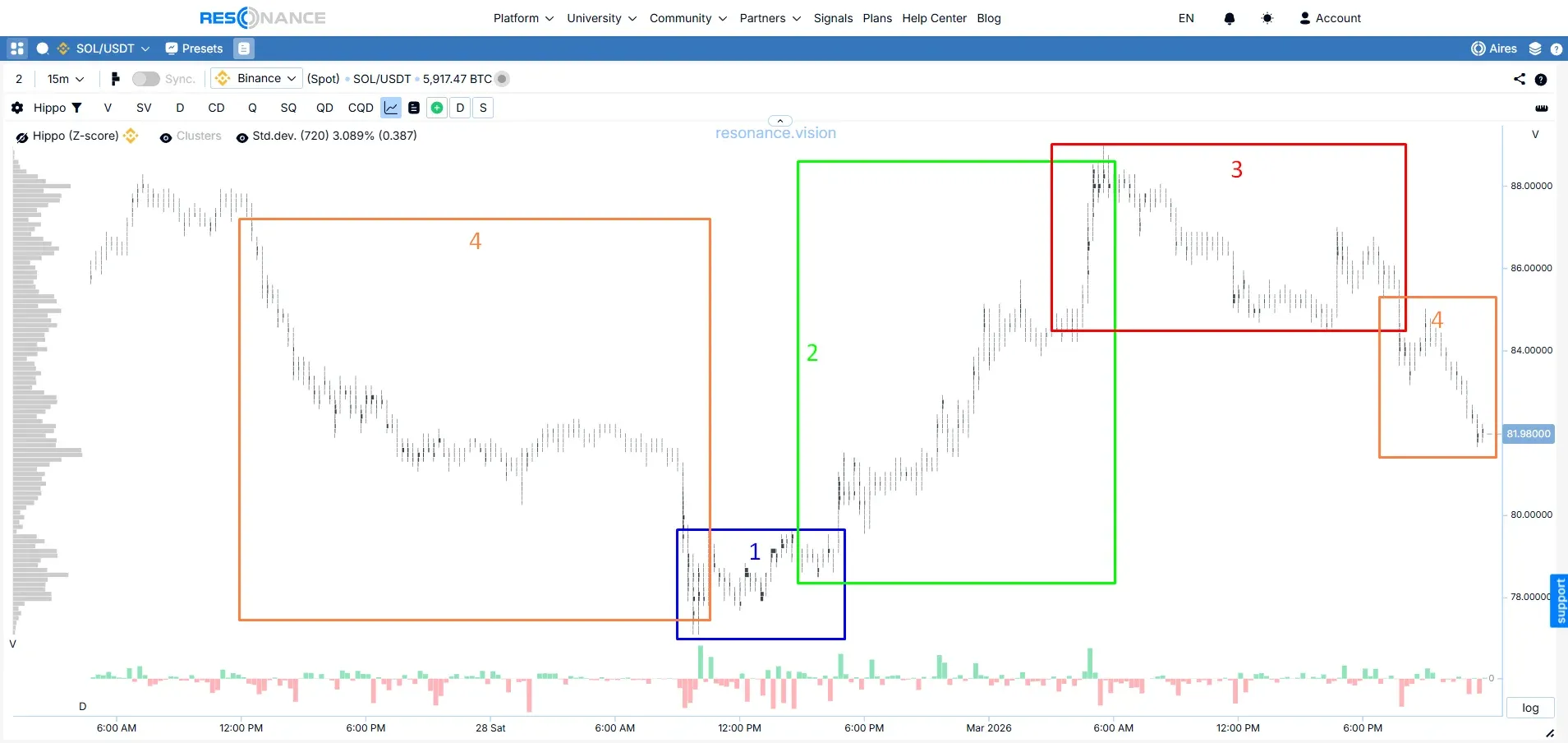
Without understanding the market phase:
- entry becomes random
- risk is not controlled
- statistics deteriorate significantly.
An important condition is also liquidity. Price moves only when there are counter orders.
If there is no one willing to buy — you will not sell.
If there is no one willing to sell — you will not buy.
For a large participant, it is especially important that there is counter volume in the market. Without liquidity, they simply will not be able to accumulate or unload a position.
Therefore, in trading it is important not just to find an asset, but to determine where there is counter interest.
It is there that movement appears — and it is there that normal entry and exit points are most often formed.
Liquidity is a condition without which the market would not exist at all.
Two Key Conditions for a Good Entry
A good entry point in trading does not appear from a set of signals.
It appears when you understand the current state of the market and see the moment in which this state begins to be realized.
Market Context: Where Advantage Appears
First, you need to determine in which phase the market is and whether there is an imbalance in it.
An entry point appears not whenever, but only at the moment when:
- a deficit or surplus is formed
- one of the sides begins to lose effectiveness
- the movement has a reason
There are sales, but the price does not decrease — it means supply is being absorbed, a deficit is forming.
There are purchases, but the price does not grow — it means demand is weaker than supply, a surplus is forming.
It is here that normal trading begins, and not an attempt to take a lottery ticket and wait to see if you get lucky or not.
Confirmation: The Moment the Movement Begins
Context alone is not enough.
You also need confirmation that the imbalance is really beginning to be realized.
Usually this is 3 facts:
- price reactions to volume
- activity of the stronger side
- change in the structure of the movement
Let’s consider an example with a coin in long:
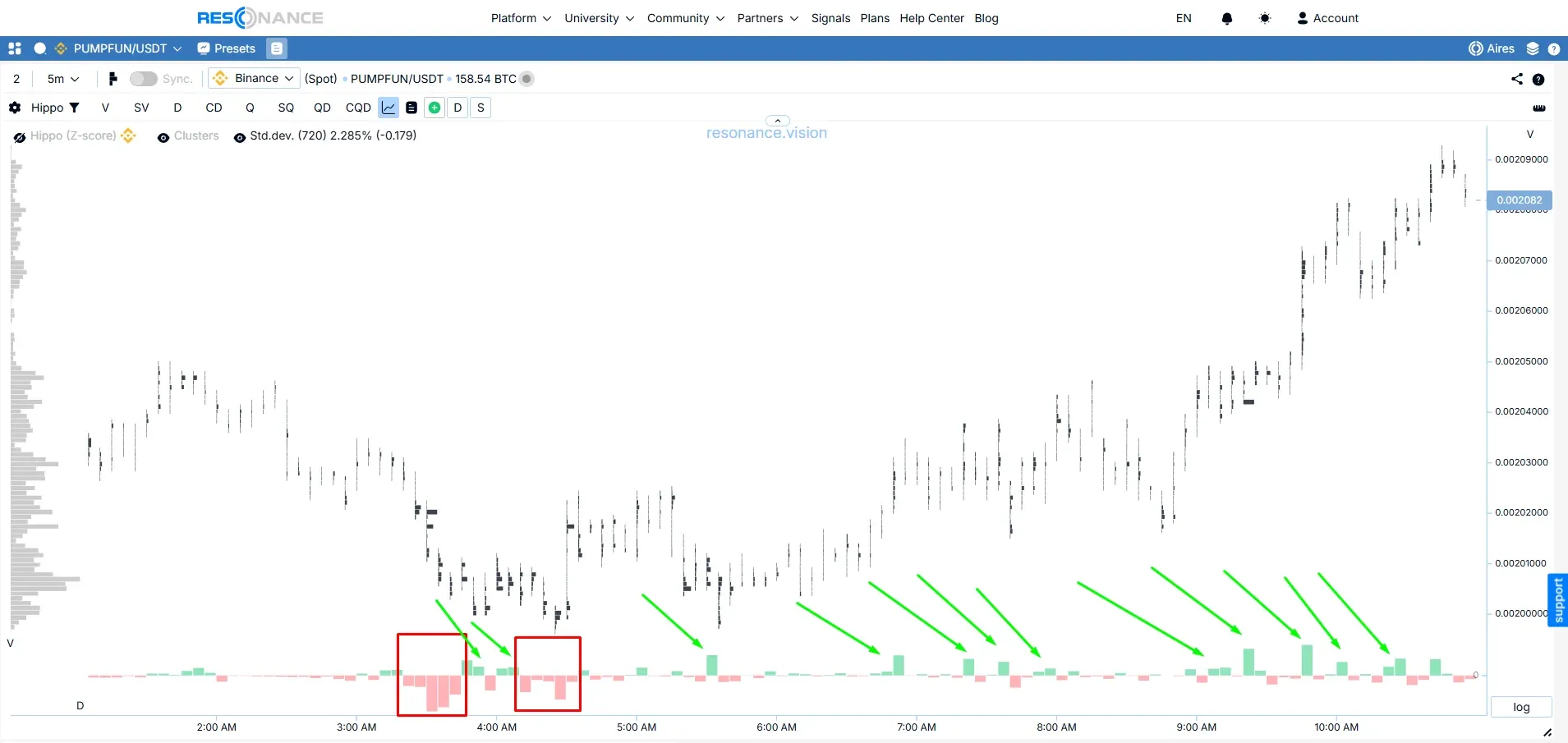
- first, sales do not move the price down
- then purchases appear in the market
- after that, the price begins to rise
This is all well read by delta. The deficit began to be realized, an entry point appears.
This is the moment in which the deficit transitions from the state of formation to the state of realization.
It is here that you can find not a random, but a justified entry point in trading. One of the best ways to find that moment is to watch how price reacts to volume.
Timing in Trading: Searching for an Entry Point
Entry at the Deficit Formation Stage
In this scenario, the imbalance is only beginning to form.
The main signs here are:
- sales volume is growing
- the price is not decreasing
- a range is forming
- limit support appears
This means that supply is gradually being absorbed. Demand has not yet begun to dominate openly, but the conditions for movement are already forming.
Such an entry is possible after confirmation of holding the range or after the appearance of the first purchases. But here it is important to understand the risk: the accumulation phase has not transitioned into the deficit realization phase. The market may remain in sideways movement for a long time, and this makes this option more risky for entry.
Entry at the Validation Stage
The strongest entry and exit points usually appear at the moment of transition from the formation of the state to its realization.
For example, with a deficit in the market, sales may prevail, but at the same time the price stops decreasing, and local lows are no longer updated. This means that supply is being absorbed and demand is beginning to form in the market.
Next, the following step is important: market purchases appear, the price begins to respond with growth and gradually shifts upward. It is at this moment that the idea receives confirmation, and a strong entry point in trading appears.
This is one of the most reliable scenarios. The deficit is no longer just forming — it is beginning to be realized. And that means the entry is carried out not on expectation, but on a confirmed market reaction. The best crypto trading entry point is the one that has context, confirmation, and clear risk.
Entry in the Realization Phase
Another option is entry along the trend, when the movement has already begun.
After an impulse, the price may give a pullback or a short consolidation. If sales do not lead to a strong price decrease, the upward structure is preserved, and the buyer continues to hold control, then you can consider entry for continuation.
This scenario is also working, but its downside is obvious: part of the movement is already behind.
That is, the idea is still relevant, but the potential will usually be less than at the validation stage.
If we simplify, the logic here is this: the earlier you managed to determine the moment of transition from the formation of the state to its realization, the better the timing in trading will be and the more successful the entry will turn out.
As a result, the scenario for opening a position in trading depends on how early you were able to see the formation of the imbalance and correctly assess the stage of the market. The more accurately you understand where the price is, the easier it is to find an entry point and not enter a trade “chasing” it.
But the entry itself is only part of the work. It is no less important to understand in advance where and under what conditions the position should be closed. Therefore, the next step is to figure out how to determine an exit point and not give back to the market what has already been earned.

Main Exit Options
Fixed Take-Profit
Suitable for short-term trading, for example day trading, where it is important to systematically take the movement.
This approach is often used when the strategy has already been tested and does not require complex management. It is implemented by placing a limit order on the exchange.
Exit on Market Phase Change
This is a more flexible option that relies on the behavior of price and volumes.
If your bet was on growth, then it makes sense to consider an exit at the moment when:
- the price reacts worse to purchases
- counter supply appears
- the movement slows down
This means that the deficit stops being realized, and the market begins to transition into the consolidation phase. In such a situation, it is important to find an exit point in time, and not wait for the continuation of the movement by inertia.
Partial Fixation
Allows you to fix part of the position and reduce risk.
This is especially convenient in cryptocurrency trading, which is characterized by volatility.
Part of the volume is closed, and part of the position continues to be held. This reduces psychological pressure.
Where to Place a Stop-Loss
A stop-loss is the point of canceling the idea, and not just limiting possible loss.
It is placed:
- behind the zone where the imbalance was formed
- behind limit support or resistance
- behind the extremum that held the price
In essence, the point of cancellation is the range in which the idea is no longer relevant.
If the price returns to this range, it means that the original logic no longer works.
In such a situation, it is important not to hope that the price will still reverse, but to fix the loss and save capital for the next trades on the exchange.
The Psychology of Timing in Trading
Mistakes in cryptocurrency trading are often associated not only with analysis.
They are almost always associated not with the market, but with the trader’s behavior.
FOMO (fear of missing out on the movement). The price has already traveled a significant path, the movement has already been partially or fully realized, but the trader still enters the position because they are afraid of missing out on profit. As a result, the entry is obtained not where there was an advantage, but where it was already time to fix profit.
The second mistake is the attempt to catch the bottom or the top.
Usually this is an entry without confirmation of a change in the market phase (essentially at the stage of uncertainty). Partly here too there is a fear of missing the movement. In the cryptocurrency market, such attempts are especially dangerous: cryptocurrency easily gives sharp movements, and without confirmation, trading ideas often result in a loss.
The third mistake is an early exit from the trade.
The price may still continue to move, but the trader closes the position too early because they are afraid of giving back the already received profit. This happens especially often in day trading, where decisions have to be made quickly, and emotional pressure is higher.
What all these mistakes have in common is one thing: they appear where there is no clear trading plan.
All these mistakes are eliminated by one tool — a strategy — a step-by-step written algorithm of actions. When a trader understands in advance where the entry is, where the cancellation of the idea is, and where the fixation is, there are fewer emotional decisions.
Checklist for Determining an Entry and Exit Point
To avoid trading blindly, but to work systematically, it is important to use a simple algorithm. It helps find an entry point and understand in advance where the exit from the position will be.
1. Determine the market phase. Understand what is happening now: is an imbalance being formed or is its realization already underway.
2. Assess the price reaction to volume is there pressure from one of the sides is the volume being absorbed how the price reacts to the actions of participants
3. Wait for confirmation activity of the stronger side appears the price begins to move in the needed direction
4. Identify the zone of idea cancellation. Where the scenario stops working. This is the future exit point if everything does not go according to plan.
5. Spot the conditions for profit fixation. What should be the reasons for closing the position: weakening of the movement appearance of counter volume transition to accumulation/consolidation
The more clearly you define entry and exit points in crypto, the easier it becomes to follow the plan.
Conclusion: Timing in Trading Is Not Guessing
Professional trading is not an attempt to guess where the price will go in the next minute. It is working with probabilities, with recurring market situations, and with an understanding of how participants behave. In crypto, timing matters as much as strategy.
A good entry does not appear by chance. It can be found only when you see the imbalance, understand the phase of the movement, and can determine which side is really gaining the advantage.
The same logic applies to the exit. It is built not on emotions, but on signs that the idea is stopping working: the movement slows down, counter volume appears, the price reacts worse to the previous impulse.
It is this approach that allows you to work systematically: not to trade randomly, to control risk, and to better understand how cryptocurrency trading works in practice. And if you want to work stably with such movements, it is important not just to open a chart on the exchange, but to learn to read the logic of the market and the actions of participants.
The best charts are cluster charts, because they help you read context, not just patterns.
Follow new insights in our telegram channel.
No need to invent complex schemes and look for the "grail". Use the Resonance platform tools.
Register via the link — get a bonus and start earning:
OKX | BingX | KuCoin.
Promo code TOPBLOG gives you a 10% discount on any Resonance tariff plan.
Recommended articles