Best Crypto Trading Books for 2027: 8 Books in Reading Order
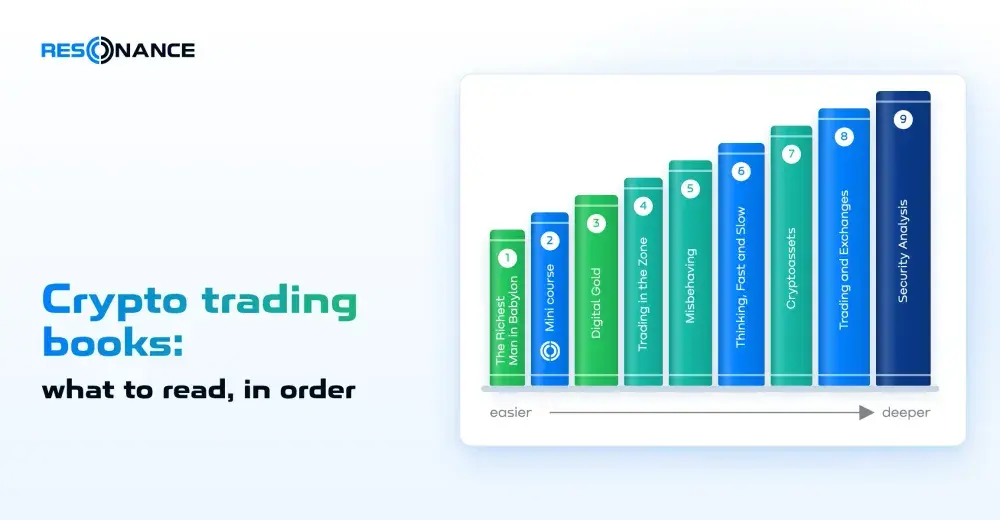
Start with The Richest Man in Babylon — a one-evening read about money and risk. Then take our free mini course: it shows on a chart what really moves the price. After that comes the history of the crypto market, trading psychology, and finally the deepest books on market mechanics and asset value. Eight books in reading order, from easiest to hardest.
Table of contents
- 01The Best Crypto Trading Books, in Reading Order
- 02Stage 1. The Foundation: Money, Risk and What Moves the Price
- 03Step 1. The Richest Man in Babylon by George S. Clason
- 04Step 2. The Resonance Mini Course
- 05Stage 2. The Market as a Force of Nature: Crypto History
- 06Step 3. Digital Gold by Nathaniel Popper
- 07Stage 3. Trading Psychology Books: You in the Market
- 08Step 4. Trading in the Zone by Mark Douglas
- 09Step 5. Misbehaving by Richard Thaler
- 10Step 6. Thinking, Fast and Slow by Daniel Kahneman
- 11Stage 4. How Markets Work: Mechanics and Asset Value
- 12Step 7. Cryptoassets by Chris Burniske and Jack Tatar
- 13Step 8. Trading and Exchanges by Larry Harris
- 14Step 9. Security Analysis by Benjamin Graham and David Dodd
- 15Which Trading Books to Skip
- 16How to Get the Most Out of Trading Books
- 17FAQ
- 18What's Next










The Best Crypto Trading Books, in Reading Order
Most “best crypto trading books” lists give you ten titles and leave the rest to you. We suggest a route instead. Each
book here answers a question left open by the one before it, and the heaviest ones come last — once you have the
foundation. Step two isn’t a book at all: it’s our free mini course, where the ideas from these books show up on a
live chart.
| Step | What to read | Author | Difficulty | Length | Question it answers |
|---|---|---|---|---|---|
| 1 | The Richest Man in Babylon | George S. Clason | easy | ~150 pages | How to handle money and how much you can risk |
| 2 | Resonance mini course | — | easy | 6 levels | What really moves the price |
| 3 | Digital Gold | Nathaniel Popper | easy | ~400 pages | How the crypto market has behaved before |
| 4 | Trading in the Zone | Mark Douglas | medium | ~250 pages | How to think about trades |
| 5 | Misbehaving | Richard Thaler | medium | ~400 pages | Why people in markets act irrationally |
| 6 | Thinking, Fast and Slow | Daniel Kahneman | hard | ~500 pages | Where decision errors come from in your own head |
| 7 | Cryptoassets | Chris Burniske, Jack Tatar | medium | ~350 pages | How coins differ from one another |
| 8 | Trading and Exchanges | Larry Harris | hard | ~650 pages | How trades work and why the price moves |
| 9 | Security Analysis | Benjamin Graham, David Dodd | hardest | ~750 pages | Why anyone buys an asset at all |
There are almost no books about crypto itself on this list, and that’s on purpose. Crypto is a capital-market asset
just like a stock, and it’s traded by the same people with the same fears. Trade mechanics, psychology and risk are
the same everywhere. Books about blockchain explain the technology, not why a coin’s price went up today.
Stage 1. The Foundation: Money, Risk and What Moves the Price
Step 1. The Richest Man in Babylon by George S. Clason
The shortest book on the route — you can finish it in an evening. It’s a set of parables about people in ancient
Babylon learning to handle money: save part of everything you earn, don’t spend more than you need, put your savings to
work and protect them from loss. That last one matters most to a trader: keeping your capital matters more than
growing it fast. Clason never mentions an exchange, but this is risk management in its simplest form: don’t invest
where you can lose everything, and never risk your last dollar.
What it looks like in the market. The Set a goal
lesson of our mini course puts the same idea in numbers: time, capital and risk are always linked — if you want to get
there faster, you take more risk. And the Compound interest
lesson is Clason’s “make your gold work for you”: part of the profit stays in the account and grows with your capital.
After this book you know how to handle money. One question remains: what actually moves the price?


Step 2. The Resonance Mini Course
The mini course is shorter than any book on this list, and it’s free. Six levels, each answering one question:
- Why are you trading at all?
- What really moves the price?
- Why does the market so often repeat the same pattern?
- How do you tell a continuation from a reversal?
- Where can the price be stopped?
- How do you turn a goal into a real route?
This is the backbone of the whole route. The books that follow go deeper into its levels: some into how people
behave, others into how trades work. The difference is that the mini course shows everything on a cluster chart
(often called a footprint chart): unlike a candle, a cluster bar shows the volume at every price — how much was
bought and sold, and where the fight happened.
Now you can see on a chart who is buying and who is selling. The next question: how has the market behaved before?
Stage 2. The Market as a Force of Nature: Crypto History
Step 3. Digital Gold by Nathaniel Popper
Reads like a novel. A New York Times reporter tells the story of Bitcoin from day one: who built it, how the first
exchanges appeared, how the price shot up tenfold and then crashed. It isn’t a textbook, but after it the crypto market
stops surprising you: hype, panic and quiet periods have all happened many times before.
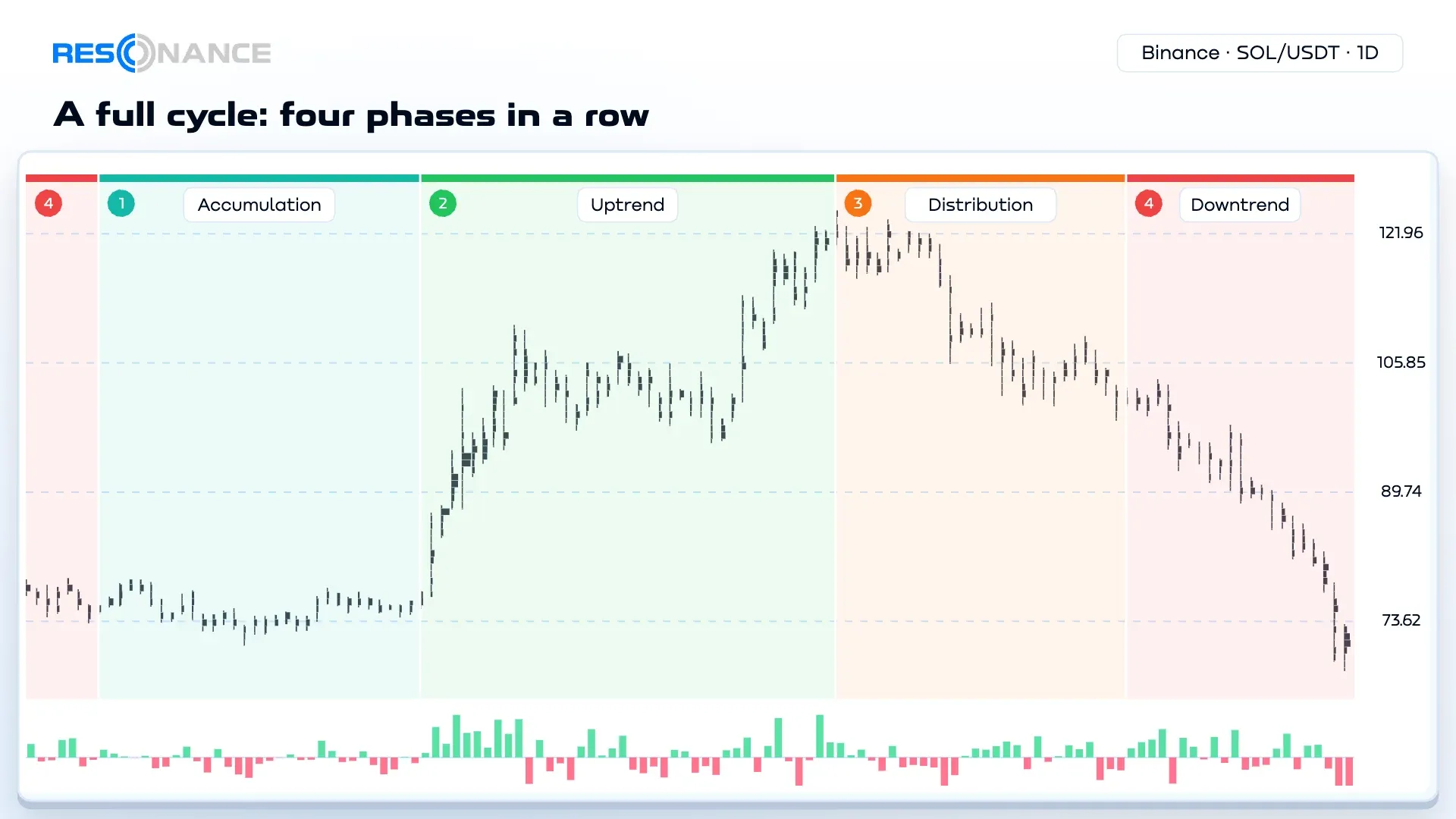
What it looks like in the market. The booms and busts in the book follow the same cycle the mini course covers in
the 4 phases lesson: accumulation, uptrend,
distribution, downtrend. The market goes through it again and again — only the range and speed change. More in our
guide to the 4 market cycle phases.
History shows that people in the market make the same mistakes over and over. Why? That’s the next stage. This is a
good moment to start practicing in the trading simulator — then the psychology
books will be about your own trades.
Stage 3. Trading Psychology Books: You in the Market
The three books in this stage go from the personal to the general: first your own series of trades, then the crowd,
then the way the mind works — the source of both your mistakes and the crowd’s.
Step 4. Trading in the Zone by Mark Douglas
The most practical book on trading psychology. Douglas’s main point: a single trade tells you nothing — you can only
judge a series. Any trade can end in a loss even if you did everything right. A trader who accepts this doesn’t move
the stop and doesn’t try to win it back — they just follow their rules over the long run.
What it looks like in the market. The mini course has a Setups
lesson — two basic scenarios that repeat in any market and on any chart scale. They are that “series”: the same
situation you meet again and again. The easiest way to check how you behave over a series is the simulator — its
stats show all your trades at once.
Douglas is about how one trader goes wrong. Does the crowd go wrong the same way?
Step 5. Misbehaving by Richard Thaler
Thaler won a Nobel Prize for showing that people don’t make economic decisions the way textbooks say. We hold on to a
losing position because we’ve “already put money in”, treat the same money differently depending on where it came
from, and overreact to fresh news. The book is lively, full of stories from the author’s own career, and has chapters
on financial markets: how investors overreact to events and how prices later come back.
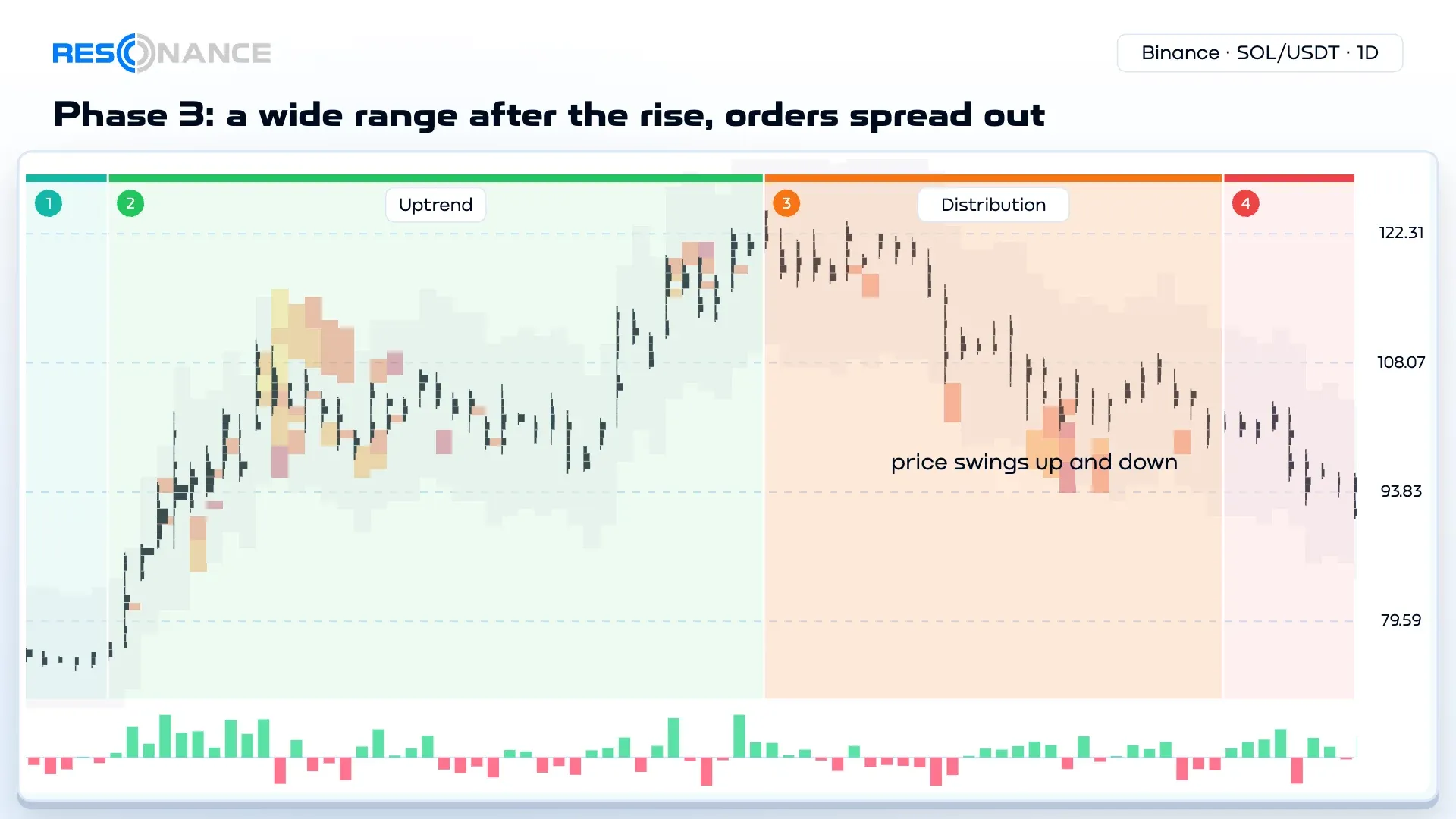
What it looks like in the market. Crowd irrationality shows up in the price range. The
Volatility lesson shows how it changes from
phase to phase: in quiet periods the price barely moves, in a frenzy it swings wide and fast. That frenzy is the crowd
acting on emotion.
Thaler shows how people go wrong. Where do these mistakes come from?
Step 6. Thinking, Fast and Slow by Daniel Kahneman
The densest book of this stage, and it reads better after Thaler, because many examples will already be familiar.
Kahneman describes two ways of thinking. Fast thinking is automatic and runs on impressions. Slow thinking is careful
and effortful, so we rarely switch it on. Almost every trading mistake is fast thinking at work: the pain of a loss
outweighs the joy of an equal gain, the “I knew it all along” feeling, conclusions drawn from your last three trades.
What it looks like in the market. The Why you need a foundation
lesson makes the same point: without a foundation, decisions are made on emotion, not by rules. The way to switch on
slow thinking is a checklist before each
trade: market phase, volatility, pressure from buyers and sellers, where the large orders sit. While you go through it,
fear isn’t the one making the decision.
Now you understand how people behave. Two questions remain: how do trades actually work, and what is an asset really
worth?
Stage 4. How Markets Work: Mechanics and Asset Value
These are the heaviest books on the route. You don’t have to read them cover to cover — but after them, the market
stops looking like a string of random moves.
Step 7. Cryptoassets by Chris Burniske and Jack Tatar
One of the first books on valuing crypto as an investment. The authors sort coins into types, explain why some have a
fixed supply while others keep growing, and show how liquidity and trading volume affect the price. The specific
examples are from 2017 and have aged, but the approach — looking at how many coins people are ready to sell and how
many to buy — still works.
What it looks like in the market. This is the law of supply and demand from the first level of the mini course,
Supply and demand. And a coin’s liquidity
shows up in the orders on the heatmap — the Liquidity
lesson.
Burniske and Tatar explain how coins differ. But how exactly do buying and selling move the price?
Step 8. Trading and Exchanges by Larry Harris
This is not a technical analysis book. It’s a textbook on market microstructure — how trading really works. Harris is a
finance professor and former chief economist of the U.S. Securities and Exchange Commission. He breaks down who comes
to the market and why: some know something, some provide liquidity, some just need to buy right now. Then come order
types, the order book, bid and ask, why a large order moves the price, and what a trader pays for urgency.
The examples come from U.S. stock exchanges, and crypto isn’t mentioned at all. But the mechanics are the same:
the price is moved by those who buy and sell at market right now, and limit orders hold it back. Books like this
almost never appear on “best trading books” lists — those are either about blockchain or about psychology. Yet what
happens on the chart every minute sits right between the two.
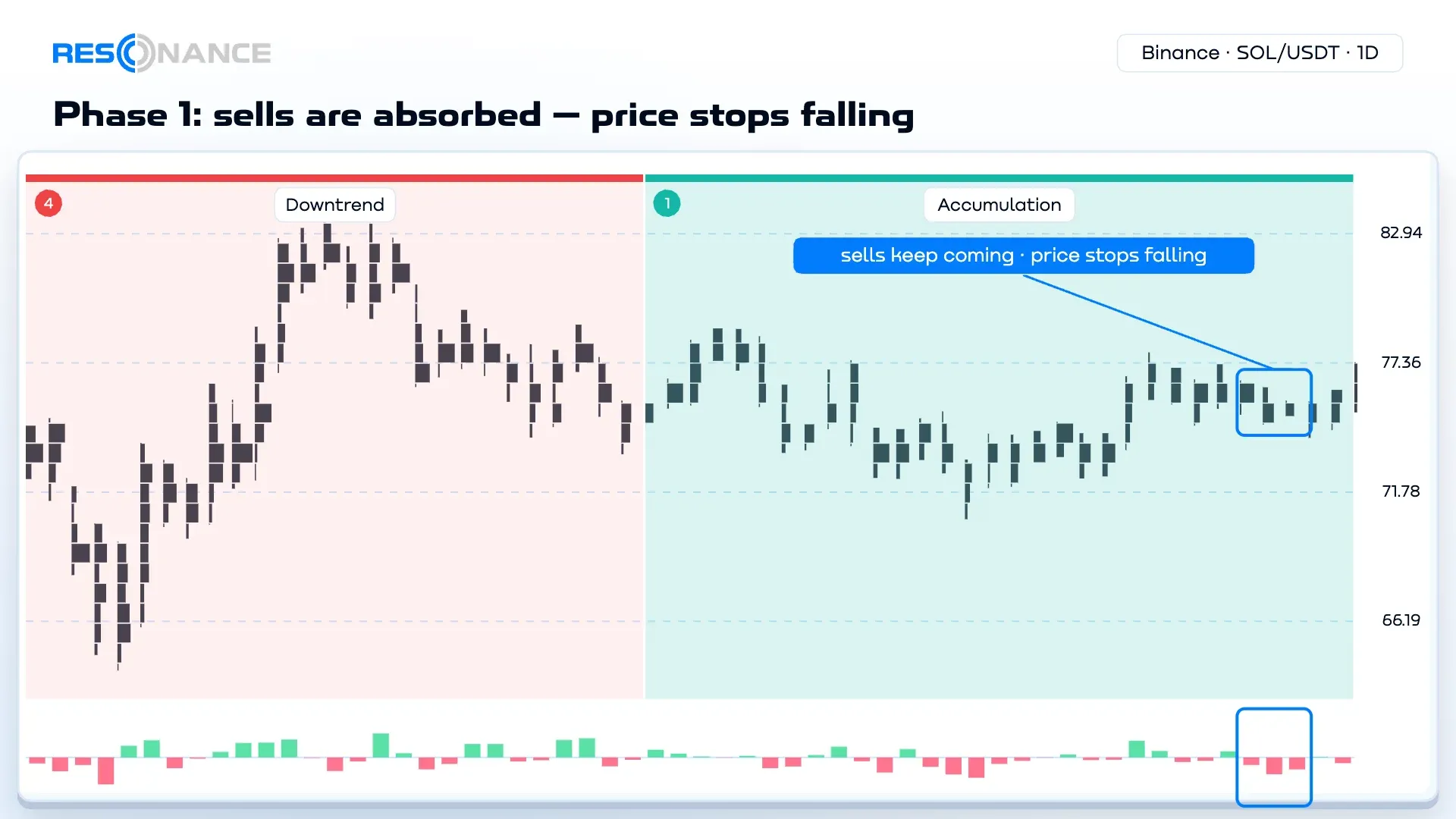
What it looks like in the market. Harris is the full version of two levels of the mini course:
Who is attacking (market orders and their
pressure on the price) and Where price will be stopped
(limit orders and the order book). The
cluster chart shows both: in each bar, how
much was bought and sold at market at every price; on the heatmap, where the large limit orders sit. If bid and ask are
new to you, start with What is BID, ASK and SPREAD.
Now it’s clear how the price moves. One last question: why buy an asset at all, and what is it worth?
Step 9. Security Analysis by Benjamin Graham and David Dodd
The end of the route and the heaviest book: thick, written in 1934, and about stocks and bonds. You don’t need to read
all of it. Its core is the difference between price and value. Price is what an asset sells for today; value is
what it’s really worth. Graham and Dodd teach you to buy when price is below value, with a margin of safety, and to
tell investing from betting on price moves. Crypto is a capital-market asset too, so the same question applies: why do
people buy it, and at what price is it worth the money?
What it looks like in the market. When price is below value, the market builds a deficit: sellers have almost
nothing left to sell, while buyers keep picking it up. In the mini course, that’s the
Supply and demand and
Market logic lessons: you buy in the right
period and hold long enough, rather than trying to guess the exact moment.
Which Trading Books to Skip
- Books that make promises like “a million in a month” or “a strategy with no losses”. They sell hope, not
understanding. - Rehashes. Many trading books just retell each other. If a book has no idea you didn’t already get from the last
one, put it down. - Chart pattern manuals. They describe the shape of the price but not who is buying and selling. Without that, a
pattern is just a picture that sometimes works and sometimes doesn’t. - Books about code and blockchain sold as trading books. They’re useful for understanding the technology, but a
coin’s price is moved by buyers and sellers, not by code.
A simple test: if a book only tells you “what to do” and never “why it works”, it isn’t worth much to a trader.
How to Get the Most Out of Trading Books
- One book at a time, in order. The route is built so each book rests on the one before.
- Check every idea on a chart. Read about market orders — find them on the cluster chart. The mini course levels
come with homework in the simulator: the best way to check whether you understood what you read. - Come back to the books after your first series of trades. Douglas and Kahneman read very differently once you
have a few dozen of your own decisions behind you.
FAQ
What is the best book to start crypto trading?
The Richest Man in Babylon — it’s short and covers the essentials: money and risk. Then take the mini course to see
on a chart what moves the price.
Do I have to read them in order?
No, but the order saves time. Each book builds on the previous one, and the heaviest come last, when you already have
the foundation.
Why aren’t these books about crypto?
Crypto is an asset just like a stock, and it’s traded by the same people with the same emotions. Market mechanics,
psychology and risk are the same in every market.
Can you learn trading from books alone?
Books give you understanding; skill comes from practice. The mini course shows the ideas from these books on a chart,
and the simulator lets you practice them on real market history without risking money.
Do I need books about blockchain?
To understand the technology — yes. To trade — no: the price is moved by buyers and sellers, not by code.
Should I read technical analysis books?
We don’t recommend them. Chart patterns describe the shape of the price, not who is buying and selling.
What’s Next
- Take the free mini course — step two of the route.
- Practice in the trading simulator on real market history.
- See what trades look like on the cluster chart.
- Read how big capital thinks
and which strategies suit beginners.
No need to invent complex schemes or hunt for the “grail”. Use the tools of the Resonance platform.
Sign up on exchanges via our links and get bonuses:
OKX | BingX | KuCoin.
Prop firm — trade with the company’s capital: Kraken.
Promo code TOPBLOG gives you 10% off any Resonance plan.
Recommended articles